
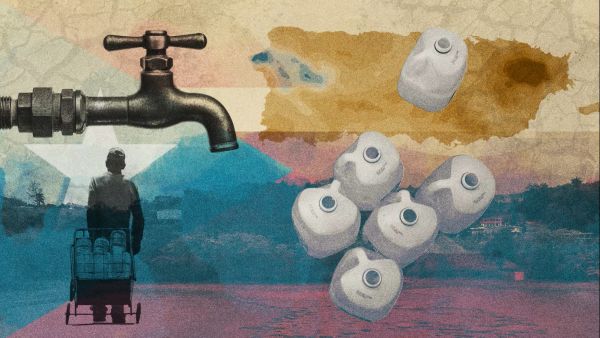
Ray Sánchez and Isabel Rosales report (for CNN) on the ongoing drought in Puerto Rico.
Milagros Pica Quiñones’ small concrete home is an untamed menagerie of bottles, paint buckets, bleach and laundry detergent jugs. The 96-year-old grandmother in the impoverished oceanfront town of Loiza, in Puerto Rico’s northeast, sees “the thinnest thread of water” trickling from her faucet most days before service is shut off from 10 p.m. until dawn. “I drag the buckets away with whatever strength I have and I cover them,” Pica Quiñones said. “Three buckets in the bathroom. One in my kitchen. Outside, I have three, two-gallon buckets. In front of the house: 15 smaller, gallon-sized containers. Next to a wall – 10 large bottles.”
The scramble to find water – collecting it in small vessels and cisterns – is a daily survival routine forhundreds of thousands of other US citizens on the island due to widespread service interruptions.The most vulnerable – the elderly, the sick, low-income people – are forced to bear the heaviest burden.
Billed as a beautiful and vibrant tourist destination, Puerto Rico is home to 3.2 million Americans who face an exhausting daily struggle for necessities like clean, running water. Pica Quiñones, whose showers consist of dipping a red Solo cup into a bucket, thinks about water all the time.

The US territory’s fragile water situation reached a new critical point over the summer – exacerbated by drought and what experts say is mismanagement and aging infrastructure, including a lack of investment and maintenance. On Friday, peoplelivingin the capital of San Juan and nearby communities completed their third full week on mandatory water rationing schedules.
Forced to endure up to two days without running water, residents must rely on bucket baths and dry shampoo, use bottled water for cooking and making coffee, paper plates and plastic utensils to eat, and occasionally forgo laundry, housecleaning and toilet flushing. All while their water bills keep coming.
“When you have a drought colliding with an aging infrastructure, that’s more than a drought. That’s a humanitarian crisis, and it’s a crisis which is deep,” said Northeastern University chemistry professor Eugene Smotkin, who lives in Old San Juan with his wife. “It’s not a drought story.”
Puerto Rico Gov. Jenniffer González-Colón declared a state of emergency July 31 due to the drought. It’s unknown how long the rationing measures will remain in place, she said. [. . .]
Below-normal rainfall could continue until next year
The capital of San Juan recorded its driest month on record in more than 120 years in July,said Emanuel Rodriguez, a hydrologist at National Weather Service in San Juan. Most of the island archipelago is experiencing moderate to extreme drought conditions, affecting more than 3 million people, according to the US Drought Monitor. Lakes and streams – some at or near record lows – are losing water amid a rainfall deficit that could last months, Rodriguez said. [. . . ]
Carlos Pesquera, a civil engineer and former secretary of transportation and head of public works who was appointed by the governor as an advisor on the water crisis, said the drought “is the immediate trigger” of the current emergency, “but it does not fully explain the vulnerability” of the water system. “Puerto Rico has aging infrastructure, significant water losses and areas where greater redundancy and resilience are needed,” Pesquera, a member of the pro-statehood governing party, told CNN via email. [. . .]
ForSmotkin, the water crisis reflects the island’s history of structural neglect and systemic abandonment by both local and federal authorities. The water woes must be seen in the context of Puerto Rico’s dependency on the United States. “The enduring image is of people standing with bottles and jugs, spending their lives trying to obtain something as elementary as water because the infrastructure that should have delivered it had failed them,” said Smotkin, who has lived on the island nearly 25 years and works to bring renewable energy sources to Puerto Rico. [. . .]
For full article, see https://edition.cnn.com/2026/08/28/us/puerto-rico-water-crisis
[Photos 1) Illustration above by Alberto Mier/CNN/Getty Images. 2) Photo by Ricardo Arduengo/AFP via Getty Images: A person fills a container from a natural spring in Trujillo Alto on August 6.]