
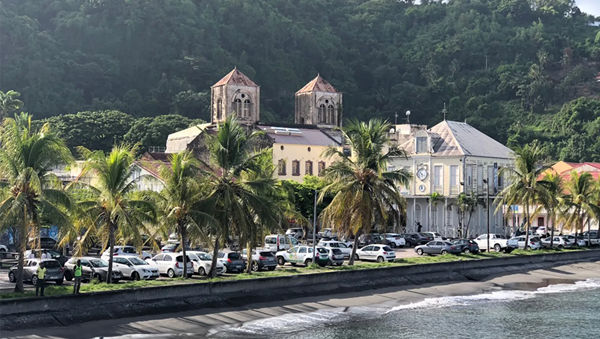
The full title of this article by Karen Udler (deputy travel editor of Caribbean Journal) is “Saint-Pierre, Martinique Is the Caribbean Pompeii, With 1902 Ruins, a 4,583-Foot Volcano, and Black-Sand Beaches.” She writes, “In Saint-Pierre, Martinique, the ruins of a city destroyed in 1902 meet Mount Pelée and the black-sand beaches of Martinique’s volcanic north…” Read the full article in Caribbean Journal, 29 August 2026).
[. . .] The old theater is still here, its stone steps climbing toward a stage that vanished more than a century ago. Nearby, the walls of the old prison remain beneath Mount Pelée, the volcano that destroyed Saint-Pierre on May 8, 1902.
Nearly 28,000 people died in the catastrophe, one of the deadliest volcanic disasters in recorded history. Mount Pelée, rising 4,583 feet above northern Martinique, still dominates the town today.
With the winter travel season approaching, Saint-Pierre is one of the places that makes a deeper Martinique trip so rewarding. It’s a Caribbean town where you can walk among 1902 ruins, swim from a black-sand beach and spend the afternoon beneath one of the region’s great volcanoes. And Saint-Pierre fits naturally into a trip through Martinique’s volcanic north, where Le Carbet combines black sand, rum distilleries and views of Mount Pelée.
The Caribbean Pompeii
Saint-Pierre was once one of the most important cities in the Caribbean.
By the beginning of the 20th century, it was Martinique’s commercial and cultural center, a thriving port of roughly 30,000 people with grand houses, government buildings, shops, churches and an ornate theater. Its wealth and French character earned it comparisons with Paris. Ships arrived from across the region and beyond, while the city became a major center of commerce for sugar and rum.
Then came May 8, 1902.
Mount Pelée had been showing signs of activity for weeks, but life continued in the city below. Shortly after 8 a.m., a devastating pyroclastic flow raced down the mountain and into Saint-Pierre.
Within minutes, almost the entire city was destroyed. The heat, ash and volcanic gases killed nearly everyone in their path. Buildings collapsed, ships in the harbor caught fire and one of the Caribbean’s great cities effectively disappeared.
More than 120 years later, you can still see what remained.
The nickname “Caribbean Pompeii” isn’t simply a flourish here. Saint-Pierre is a living town built in and around the remnants of the city that was lost.
Walking Through the Old City
Part of what makes Saint-Pierre so compelling is how naturally the ruins appear.
You don’t enter a single archaeological park and leave history behind when you walk out. Stone walls, arches, staircases and foundations appear between present-day streets and homes. [. . .]
Mount Pelée is also one of Martinique’s signature hiking experiences. Several routes lead toward the summit, passing through high-elevation volcanic terrain that feels far removed from the beaches farther south. Conditions can change quickly at altitude, and the mountain deserves preparation.
Even if you never climb it, Saint-Pierre gives you one of the most powerful ways to experience Mount Pelée. The history of the volcano is visible everywhere in the town beneath it.
The mountain is also part of the UNESCO-listed Volcanoes and Forests of Mount Pelée and the Pitons of Northern Martinique. The designation recognizes the extraordinary biodiversity and volcanic geography of this part of the island, giving northern Martinique another reason to merit more than a quick excursion from the south. [. . .]
For full article, see https://www.caribjournal.com/2026/08/29/caribbean-pompeii-saint-pierre-martinique/