
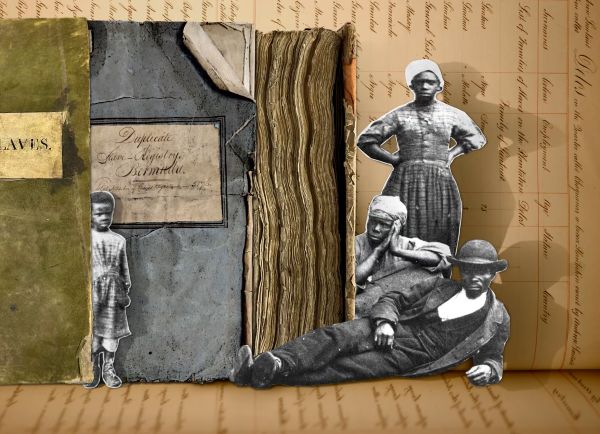
[Many thanks to Peter Jordens and Veerle Poupeye (Critical.Caribbean.Art) for bringing this item to our attention.] In this article, Aamna Mohdin (The Guardian) writes about a collection named the Former British Colonies Enslavement Registers, which contains about 300,000 pages recording enslaved people across former British colonial dependencies between 1813 and 1840, including the Bahamas, Barbados, the Cape of Good Hope in South Africa, Jamaica, Mauritius and Trinidad. Read excerpts below and see full article and illustrative documents at The Guardian. [This post is followed by Peter Jordens’s timely list of links to related articles.]
Nearly 4m records documenting the lives of enslaved people across 20 former British colonies have been made searchable online for the first time.
The records have been digitised and indexed by the genealogy company Ancestry, which has partnered with the Centre for the Study of the Legacies of British Slavery at University College London.
The global collection offers millions of descendants across the African-Caribbean and wider African diasporas access to one of the most extensive surviving archives of British enslavement, potentially helping them uncover family histories.
The collection, known as the Former British Colonies Enslavement Registers, contains about 300,000 pages recording enslaved people across former British colonial dependencies between 1813 and 1840, including the Bahamas, Barbados, the Cape of Good Hope in South Africa, Jamaica, Mauritius and Trinidad.
The registers were created by the British government after the abolition of the transatlantic slave trade in 1807, and were designed to prevent illegal trading of enslaved people and to monitor the enslaved population.
Researchers say people were recorded in the registers with chilling precision. Entries include names, ages, physical descriptions and family ties, as well as births, deaths and transfers of ownership. Some distinguish whether a person was born in Africa or in the Caribbean.
Nicka Sewell-Smith, a professional genealogist and senior story producer at Ancestry, said it was not lost on her that records originally created to count enslaved people as property were now being used by their descendants to reconstruct their family histories. [. . .]
[Shown above: A composite by Guardian/Getty/British Enslavement Registers. Archival images from British Enslavement Registers/T71 collection. Composed with selections from a portrait of Civil War ‘contrabands,’ fugitive slaves who were emancipated upon reaching the North of the US in the 1860s.]
Also see:
What is the Register of British Slave Traders and whom does it identify?
David Conn, The Guardian, September 14, 2026
https://www.theguardian.com/uk-news/2026/sep/14/register-british-slave-traders-africa-research
Monarchs, MPs and merchants: the register laying bare Britain’s slave-trading past
David Conn, The Guardian, September 14, 2026
https://www.theguardian.com/uk-news/ng-interactive/2026/sep/14/register-british-slave-traders
The royal crown branded on enslaved Africans: Britain’s monarchy and the slave trade
David Conn, The Guardian, September 14, 2026
https://www.theguardian.com/uk-news/ng-interactive/2026/sep/14/royal-crown-branded-africans-britain-monarchy-slave-trade-trafficking
Slavery was not a footnote to British history. It helped shape the nation
William Pettigrew, The Guardian, September 14, 2026
https://www.theguardian.com/uk-news/commentisfree/2026/sep/14/slavery-britain-history-slave-trade-register-africans
The London hospital funded by donors who invested in the slave trade
Morgan Ofori and David Conn, The Guardian, September 14, 2026
https://www.theguardian.com/uk-news/ng-interactive/2026/sep/14/london-hospital-st-barts-funded-donors-invested-slave-trade