
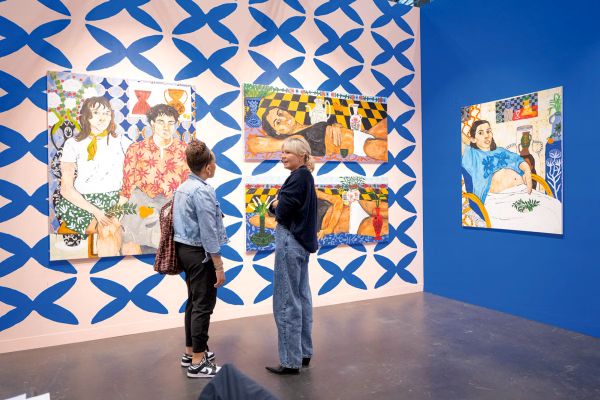
The Armory Show is over (September 24-27, Javits Center, New York) but this review by Carlie Porterfield for The Art Newspaper captures the essence of Caribbean representation this year. Porterfield writes, “New York’s biggest art fair has revamped its footprint to place artists of the Caribbean and its diasporas in the foreground, as well as stalwarts of the hometown scene.” Here are excerpts from The Art Newspaper.
This month’s edition of The Armory Show centres the Caribbean in both its curated sections and how stands are situated in relation to the fair’s two primary entrances. Organisers have rearranged the fair’s layout to put artists and galleries from the region and its diasporas in the foreground. In total, around 230 galleries from more than 30 countries will participate this year (24-27 September), with the sections devoted to emerging galleries and solo presentations taking more square footage.
This edition’s floorplan uses the Javits Center’s two main entrances to introduce visitors to distinct geographic curatorial narratives. The south entrance will lead attendees directly into the fair’s Caribbean focus, bringing together galleries and artists from across the region and the wider Americas. Among the programming highlights at the south entrance is El Apartamento, the Havana-founded gallery, which is showing a group exhibition of Cuban artists, alongside solo presentations by the Haitian American artist Kathia St. Hilaire on Perrotin’s stand, the California- and Colombia-based painter Shara Mays with Ronchini and the Brazilian artist Antonio Luiz Morais de Andrade with the São Paulo-based Galeria Raquel Arnaud. [. . .]
A Caribbean framework
The Armory Show’s director, Kyla McMillan, says the Caribbean and its diasporas were chosen as the fair’s geographic theme this year partly because the region serves as a connecting point for much of the Americas, stretching from the southern edge of North America, through Central America and the Caribbean islands to the northern coast of South America.
“It felt like a really exciting opportunity to speak about the throughlines in the region that are really important for us [as a] New York fair that is very reflective of a diaspora, but also feels regional,” she says. That thinking extends into the fair’s curated programme, with both the Platform and Focus sectors using the Caribbean as a shared point of departure, though the two sections take markedly different approaches.
Platform, devoted to large-scale works and curated this year by Jovanna Venegas of SculptureCenter in Queens, examines architecture, materiality and resourcefulness across the Caribbean through sculpture and installation. McMillan says the section is intended to broaden conventional ideas of Caribbean art by exploring how artists respond to the region’s physical and environmental conditions. Highlights include works by the Dominican-born artist Bony Ramírez (presented by Regularnormal), the Dominican American artist Lucia Hierro (showing with Marc Straus Gallery), the Cuban-born artist Rafael Domenech (with 193 Gallery), the sculptor Zenobia Lee (with Sea View), the Mexico-born artist Margarita Cabrera (with Jane Lombard Gallery), the Cuba-born artist María Magdalena Campos-Pons (with Galerie Barbara Thumm) and the Guyanese British artist Hew Locke (with Cristea Roberts Gallery).
“The goal is always to expand what we think Caribbean art can look like, or expand whatever the curatorial focus is,” McMillan says. “What’s been interesting is the exploration of material. Sometimes it is in response to resources available, sometimes it’s in response to ecological challenges—a lot of the Caribbean deals with hurricanes and what it is to rebuild after that.”
The fair’s Focus sector, curated by María Elena Ortiz of the Modern Art Museum of Fort Worth, puts works by artists living in the Caribbean alongside those whose practices have been shaped by migration and diasporic communities, while also showcasing galleries from the region. Participants include Casa Hoffmann from Bogotá, which will show works by the Colombian artist Alba Triana; a joint stand from New York’s Henrique Faria Fine Art and Bogotá-based Galería SN featuring works by the Colombian painter Ana Fernández Mosseri and the Venezuelan multimedia artist Mercedes Elena González; the Brooklyn-based gallery Mimo and Hidrante from Puerto Rico showing the Dominican-born artist Ernesto Rivera and the Puerto Rican painter Ricardo Cabret; and Tern Gallery from the Bahamas showing Bahamian artists Gio Swaby and Kachelle Knowles. The section is complemented by presentations from galleries outside the region, including Tribeca’s Chozick Family Art Gallery presenting works by the Puerto Rican artist Sofía Del Mar Collins, the Chelsea-based Ethan Cohen Gallery showing the Jamaican American artist Renée Cox, Patron from Chicago showing works by the Jamaican artist Simon Benjamin, Lower East Side gallery Proxyco presenting the Dominican American artist Lizania Cruz, and the Miami-based spaces Mindy Solomon Gallery and Spinello Projects showing Yanira Collado and the brothers Elliot and Erick Jiménez, respectively.
McMillan says another thread running through this year’s fair is an emphasis on movement and performance as features of the region’s artistic traditions. “The Caribbean is a place where there are so many iterations of carnival—we’re thinking about procession, movement and performance as part of the work,” she says. “So many of the cultures and the art forms are rooted in activity. I’ve really been excited to see that come through.” [. . .]
For full article, see https://www.theartnewspaper.com/2026/09/21/the-armory-show-2026-preview-caribbean-artists-galleries
[Shown above: On the topic of the tropics: The Armory Show celebrates the influence of the Caribbean and its diasporas on New York City and the rest of the Americas
Photo by Casey Kelbaugh/CKA.]