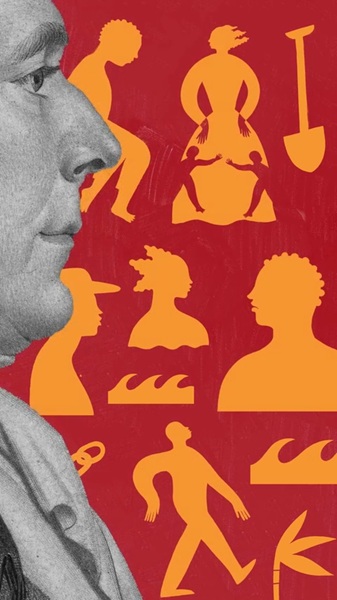
David Conn (The Guardian, 14 September 2026) writes about the Register of British Slave Traders and research that identifies thousands who profited from trafficking enslaved Africans and traces some financial links to institutions still operating today. Here, Conn examines the trajectory of enslavement and trafficking as state policy and the ironies of the “free trade” ideology. The article is accompanied by illustrations by Diana Ejaita. Read excerpts below and read the full article at The Guardian. [Many thanks to Peter Jordens for bringing this item and all related links to our attention. Also see our previous post Nearly 4m records of enslaved people.]
The big picture
The enormous scale of Britain’s centuries-long trafficking of enslaved African people, supported by parliament and the monarchy, has been laid bare by new research. The Register of British Slave Traders, the product of a three-year project by a team of specialist historians, documents the investors in Britain’s near 250-year transatlantic slave trade from the first traffickers in the 1560s to abolition in 1807. The register provides biographical detail for as many of 10,500 investors as possible from historical records, building the most comprehensive single picture so far of those who perpetrated the enslavement of African people.
Britain’s trafficking operations, including royal companies led by kings and, later, a rush of entrepreneurs in Bristol, Liverpool and other port cities, violently transported more than 3 million enslaved African men, women and children to colonial plantations in the Americas and Caribbean.
The Guardian is reporting on significant findings of the project, led by Prof William Pettigrew of King’s College London, and the vast human damage it documents: the relentless involvement of the British monarchy, parliament and financial and business elites; the role of the church in legitimising it; and how the investors’ wealth was woven deep into the country’s fabric and used to fund hospitals, schools, welfare organisations, the arts, science and culture.
Key elements include:
- A series of British kings and queens were leaders and investors in the trafficking of enslaved African people;
- More than 100 MPs were investors in slave-trading companies, including scores in the Tory and Whig parties – the forerunners of today’s Conservatives and Liberal Democrats;
- Dozens of directors and original financiers of the Bank of England were investors in the slave trade;
- More than 1,000 women invested in slave-trading companies;
- Forty-five Church of England clergymen were investors in the slave-trading Royal African Company.
The BBC is showing a two-part documentary about the register, presented by the historian David Olusoga.
The publication of the register will provide further evidence for the growing global movement calling on European governments to acknowledge their perpetration of enslavement, issue a full, formal apology and engage positively with discussions for reparatory justice. Successive British governments have refused to do so, arguing there is no duty to make reparations because enslavement and the slave trade were not against the law at the time.
An official delegation from Jamaica delivered a petition to King Charles last week to seek a legal ruling from the privy council, the final court of appeal for UK overseas territories and some Commonwealth countries, on whether that government position is lawful.
Famous names, hidden histories
[. . .] Of the thousands of British slave traders identified in the register, some are household names: King James II, the last Catholic monarch to rule England, Scotland and Ireland whose statue celebrating him as a “defender of the faith” stands in Trafalgar Square, London; the composer George Frideric Handel; and the philosopher John Locke, both shareholders in the Royal African Company (RAC). [. . .]
For decades, piratical shipowners enslaved and trafficked people from the west African coast – mostly from present-day Ghana and Nigeria – to the Caribbean and North America. In the 1600s merchants followed, establishing plantations, including sugar in Barbados.
A twist of historical cruelty
British plantation owners enslaved African men and women and children – who were born enslaved for life – to extract their unpaid labour, enforcing enslavement through extreme violence. It is a further twist of cruelty that this oppression was enforced to deliver treats to people in a modernising Europe: tobacco and sugar. [. . .]
Full deregulation was approved by parliament in 1712, and the new British ideology of “free trade” enabled a dramatic increase in the number of African people denied their liberty,enslaved and trafficked. [. . .]
For full article, see https://www.theguardian.com/uk-news/ng-interactive/2026/sep/14/register-british-slave-traders
Also see:
What is the Register of British Slave Traders and whom does it identify?
David Conn, The Guardian, September 14, 2026
https://www.theguardian.com/uk-news/2026/sep/14/register-british-slave-traders-africa-research
The royal crown branded on enslaved Africans: Britain’s monarchy and the slave trade
David Conn, The Guardian, September 14, 2026
https://www.theguardian.com/uk-news/ng-interactive/2026/sep/14/royal-crown-branded-africans-britain-monarchy-slave-trade-trafficking
Slavery was not a footnote to British history. It helped shape the nation
William Pettigrew, The Guardian, September 14, 2026
https://www.theguardian.com/uk-news/commentisfree/2026/sep/14/slavery-britain-history-slave-trade-register-africans
The London hospital funded by donors who invested in the slave trade
Morgan Ofori and David Conn, The Guardian, September 14, 2026
https://www.theguardian.com/uk-news/ng-interactive/2026/sep/14/london-hospital-st-barts-funded-donors-invested-slave-trade