
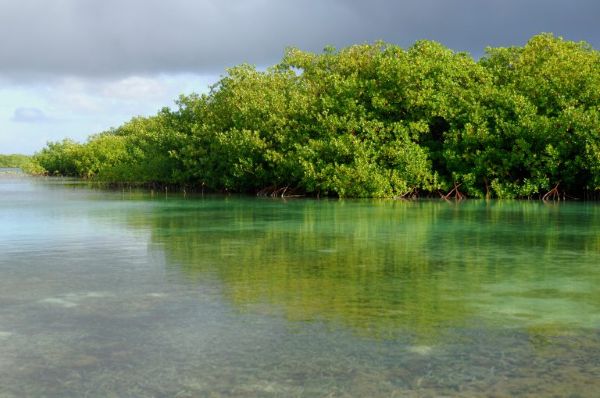
Here is an older article by Iris Holtkuile from the Dutch Caribbean Nature Alliance (DC Nature, 9 June 2026). We share this excellent, informative article because the circumstances of mangroves in Bonaire may be familiar and resonate for many of us in the broader Caribbean. Here are excerpts; read full article at DC Nature.
Researchers from the University of Twente, Mangrove Maniacs, and Wageningen Marine Research recently completed a field study within the mangroves in Lac Bay, Bonaire. The goal? To better understand how water and mud move through the mangrove forest, especially in Awa di Lodo, an area where many mangroves have struggled in recent years. Over time, most of the natural water channels became blocked, which stopped seawater from flowing properly through the area. The team measured water levels, tides, and sediment movement to learn what the mangroves need to stay healthy. Their work is helping scientists and nature organizations better protect mangroves in Bonaire and across the Dutch Caribbean.
Small changes, big problems: One of the biggest surprises was how sensitive the mangroves are to very small changes in the tides. When the water level rises just a little higher, seawater can flow deep into Awa di Lodo and help “flush” the system, almost like cleaning out a clogged pipe. This helps lower salt levels and keeps the mangroves healthier. When tides stay low, much less water enters the area, and the water becomes too salty for many plants to survive. Researchers also discovered that a restored water channel behaved very differently from a natural one, and even helped in moving mud out into the bay, reducing blockages. The study showed that mangrove restoration is not just about digging channels. Tiny differences in shape, depth, and water flow can completely change how the system works.
Why This Matters for the Dutch Caribbean: Mangroves are one of the most important ecosystems in the Dutch Caribbean. They protect coastlines from storms, store carbon, support fisheries, trap sediment, and help keep nearby coral reefs and seagrass beds healthy. But across the Caribbean, mangroves are under increasing pressure from erosion, sediment runoff, rising temperatures, and reduced water circulation. This research provides valuable insight into how restoration projects can be designed more effectively, especially on small islands where tidal ranges are naturally limited. The findings are also highly relevant to ongoing conservation work under the new Key Habitats Program, where mangroves are recognized as one of the region’s most critical habitats. Understanding how these ecosystems “breathe” through tidal flushing will help conservation organizations make smarter decisions to improve long-term resilience for both nature and local communities.
Protection starts on land: The research also reinforces an important lesson: healthy mangroves depend on healthy landscapes upstream. Excess sediment runoff from erosion and land degradation can clog tidal creeks, reduce water exchange, and increase stress on mangrove forests. Residents, visitors, and local organizations can all help by supporting restoration projects, reducing erosion, protecting native vegetation, and learning more about the connection between land and sea. Mangroves are not isolated ecosystems. They are directly linked to coral reefs, seagrass beds, fisheries, and coastal protection throughout the Dutch Caribbean. [. . .] For full article, see https://dcnanature.org/bionews-waterflowmangroves/