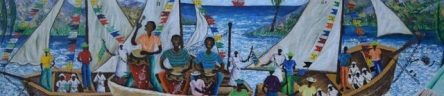
Pablo Delano’s “The Museum of the Old Colony” is the artist’s first solo exhibition in Brazil. The installation “brings together around 300 photographs and objects that invite reflection on the history of Puerto Rico, considered the world’s oldest colony.” It will be on view at the Museu de Arte de São Paulo Assis Chateaubriand (MASP) in São Paolo, Brazil, from October 30, 2026, to January 31, 2027.
MASP CONVERSATIONS: On the day the exhibition opens to the public, October 30, at 7:00pm, artist Pablo Delano and curator Fernando Oliva will discuss the project with the audience. [The event is free and will take place in person, with simultaneous Portuguese to Spanish interpretation (headsets can be collected upon presentation of a photo ID) and Brazilian Sign Language (Libras) interpretation. A recording will subsequently be made available on MASP’s YouTube channel.]
Description: The MASP — Museu de Arte de São Paulo Assis Chateaubriand — presents Pablo Delano: The Museum of the Old Colony from October 30, 2026, to January 31, 2027. The exhibition is the first solo show in Brazil by the Puerto Rican artist. A visual artist and photographer known for his work with archives and the memory of Latin American and Caribbean peoples, Pablo Delano (Puerto Rico, 1954) offers, in this exhibition, a reflection on the political and social status of his homeland, considered the oldest colony in the world.
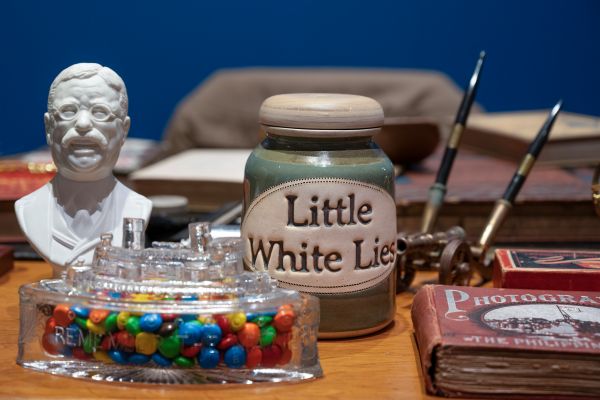
Curated by Adriano Pedrosa, artistic director, MASP, and Fernando Oliva, curator, MASP, the exhibition centers on the project The Museum of the Old Colony, which brings together images, objects, and documents related to Puerto Rico’s colonial history, from Spanish rule to the island’s current status as an unincorporated territory of the United States. The installation functions as “a museum within a museum,” reproducing and, at the same time, questioning traditional ways of organizing, classifying, and presenting objects and images. Historical photographs are enlarged and mounted directly on the walls, without frames, alongside everyday objects—such as bottles of Old Colony soda, a product created in the United States and now sold almost exclusively in Puerto Rico, which gives the exhibition its title.
“Pablo Delano offers a different way of looking at the history of Puerto Rico and its colonization by the United States. It is certainly more critical, but also imbued with a certain wit and irony, as if to remind us that even denunciation and resistance can use humor as a viral and disruptive strategy,” says Fernando Oliva.
Puerto Rico’s history shares many points of connection with Brazil’s, including a colonial and slaveholding past imposed on Indigenous and Black populations, which has left deep marks on the societies, economies, and cultures of both countries. “The main question we can ask ourselves when faced with Pablo Delano’s proposal for MASP is: what resonance can the term ‘anticolonial’ have in Brazil today? This exhibition offers an opportunity to confront this dilemma,” says the curator. “In the context of a geopolitical situation in which Latin America is systematically threatened by the warmongering rhetoric of a new US colonialism, Delano’s work takes on an even greater sense of urgency.”
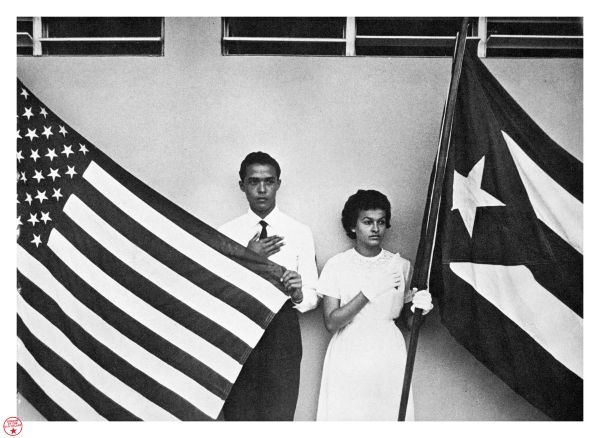
Claimed by Spain in 1493 and transferred to US control in 1898 following the Spanish-American War, Puerto Rico is today defined as an “unincorporated territory” that belongs to the United States but is not part of it. Puerto Ricans were granted US citizenship in 1917; however, those who live on the island cannot vote in US presidential elections, among other restrictions. This kind of ambiguity permeates Delano’s museum, which explores how photography, advertising, and everyday objects are used to construct stereotypes and promote an image of a “tropical paradise” that seeks to conceal exploitation and violence.
The Museum of the Old Colony directly engages with the anti-colonial project developed by MASP since its founding in the late 1940s, drawing on the ideas of Lina Bo Bardi and Pietro Maria Bardi. “From its very beginnings, the museum embraced a non-Eurocentric vision, conceiving of the museum as an institution that would bring together multiple forms of knowledge, originating not only from artists in the canonical Western sense, but from anyone able to make a contribution,” Oliva explains. In 1968, MASP introduced the glass easels designed by Lina to display its collection, placing works from the European canon and those by Brazilian artists, including self-taught creators, on the same material, symbolic, and visual plane. “Like Lina Bo Bardi in the 1960s, Delano’s work also seems to ask what an art exhibition in a museum means today—a place created in the context of colonization that, for centuries, served to reaffirm the structures and representations of that very colonialism,” says Fernando Oliva.
The Museum of the Old Colony was part of the 2024 Venice Biennale, curated by Adriano Pedrosa, and has previously been exhibited at institutions in Puerto Rico, the United States, Argentina, Jamaica, and Trinidad and Tobago.
Pablo Delano: The Museum of the Old Colony is part of MASP’s annual program dedicated to Latin American Histories. The year’s program also includes exhibitions of works by Jesús Soto, Rosa Elena Curruchich, Manuel Herreros and Mateo Manaure, Carolina Caycedo, Sol Calero, Damián Ortega, Colectivo Acciones de Arte, Claudia Alarcón & Silät, La Chola Poblete, Santiago Yahuarcani, and Sandra Gamarra Heshiki. [. . .]
Pablo Delano was born in 1954 and grew up in Puerto Rico. He moved to the US East Coast in the early 1970s to study art, settling in New York in 1979. He initially worked as a painter but soon turned to photography, a skill he inherited from his father, photographer Jack Delano. In 1996, Delano accepted a teaching position at Trinity College in Hartford, Connecticut, which gave him the opportunity to travel to Trinidad and Tobago, in the southern Caribbean. He returned to the country many times over the following ten years and, in 2008, published a book of black-and-white photographs titled In Trinidad, exploring the process of postcolonial nation-building. In the late 1990s, Delano began collecting archival images of Puerto Rico to address the island’s colonial status. This initiative gave rise to his installation The Museum of the Old Colony, which has been exhibited at museums around the world since 2016. In 2025, Delano presented the exhibition cuestiones caribeñas / caribbean matters at the Chazen Museum of Art in the United States, exploring Caribbean history and the realities shared by Caribbean territories.
[Posted above: 1) Pablo Delano’s “Two Flags,” 2020; and 2) “Little White Lies” (assemblage); The Museum of the Old Colony]