
Many thanks to Peter Jordens for sharing this item. As he explains, the five cases discussed by Alex Bowers (Breathe Magazine) include the pigs of Big Major Cay, Exuma, The Bahamas; and the monkeys of Cayo Santiago, Humacao, Puerto Rico. Other animal residents described in the article are the horses of Sable Island, Nova Scotia, Canada; the cats of Aoshima, Japan; and the puffins of Lunga, Scotland. [Jordens also provides links to recent scientific publications on the rhesus macaques of Cayo Santiago. See more information below.]
From a Bahamas beach brimming with swimming pigs to a Scottish cliffside crowded with puffins, these remote islands are home to unlikely animal residents – and quietly remarkable stories of survival, science, and serendipity.
In famed French novelist Jules Verne’s 1864 science-fiction novel, Journey to the Centre of the Earth, there’s a strange, subterranean sanctuary where prehistoric creatures – hidden from the prying eyes of humanity – continue their reign in relative peace. Aside from the fantastical element, it’s hard to imagine a real-world scenario where animals exist without any interference from people. Today, humans dominate much of the globe and have set up camp on every continent and across numerous widely scattered islands. Geographical isolation doesn’t always offer the protection to wildlife that it once did, as technological advances continue to open up paths to previously unreachable lands.
Despite this, however, there remain pockets where animals continue to flourish. Among them are several islands, which, through either planned introduction or natural conditions, have become unique (if sometimes controversial) habitats for certain species. Indigenous creatures are completely at home, while those introduced by human hands – often via colonialism or piracy, but occasionally for conservation or scientific purposes – have adapted to the environment in which they’ve involuntarily been placed. Some of the species in the latter category have become invasive, which has had a detrimental impact on local wildlife, though it’s worth remembering that there are other population explosions that have happened purely by chance.
Whatever the background, these unique places – from a Bahamas beach brimming with pigs to a Scottish cliffside crowded with puffins – are undeniably curious and quirky, perhaps even worthy of a science-fiction tale of their own. [. . .]
2. The pigs of Big Major Cay, Bahamas
Location: The Exumas, Bahamas | Famous for: Swimming pigs that paddle out to greet tourist boats
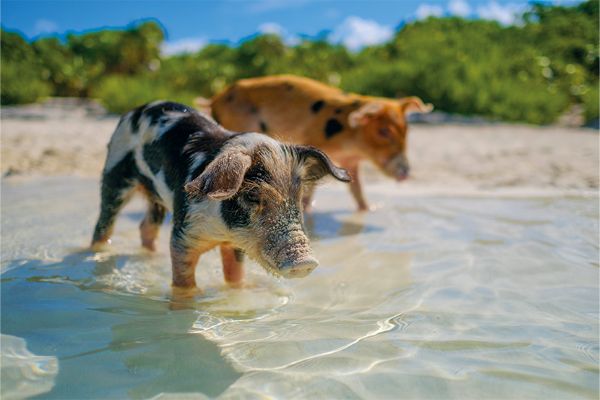
The Exumas, a Bahaman archipelago of over 365 islands (also known as cays), renowned for its white-sand beaches and turquoise waters, is home to sea turtles, tropical fish, and reef sharks. Less expected, perhaps, is the sight of hungry pigs swimming from the beach of Big Major Cay towards tourist boats, their little legs paddling tirelessly, their snouts lifted in the air, grunting. Some say the pigs were left on the island by sailors in colonial times, or even pirates, who intended to come back and eat them but never did. Another theory suggests they were survivors of a centuries-old shipwreck, swimming to shore and settling beside land crabs, iguanas, and non-poisonous snakes, their numbers growing steadily over generations.
An alternative story goes that decades ago, when tourism to the Exumas was in its infancy, pig-breeding helped sustain the island’s community. The stench of domestic pens in the summer heat was so bad, however, that the hogs were moved to nearby Big Major Cay. And then there’s the claim by an American man that he brought the first pigs to the island with his business partner in the late 1990s, to ensure a food supply in case the feared Y2K computer meltdown became a reality.
In the past, the pigs were considered a tourist deterrent but now people come from far and wide to see them trot along the beach or wade into the ocean.
3. The monkeys of Cayo Santiago, Puerto Rico
Location: Off the coast of Puerto Rico | Population: over 1,600 rhesus macaques

Cayo Santiago, a small island off the coast of Puerto Rico, harbours upwards of 1,600 primates, descended from 409 rhesus macaque monkeys brought from India for scientific observation in the late 1930s. The colony is monitored by the Caribbean Primate Research Centre and the University of Puerto Rico Medical Sciences Campus, both of which leave the animals to form social groups, define territories, and roam freely across the 15-hectare private island. The researchers’ minimal intervention involves feeding and health checks. Otherwise, primatologists are there only to study and better understand the monkeys.
In 2017, Hurricane Maria caused widespread damage to Cayo Santiago, including to vast swathes of vegetation. It was believed the rhesus macaque population would be devastated by its effects. But nearly all of them weathered the storm and survived. Scientists later observed that the monkeys formed stronger bonds within their respective networks post-hurricane, demonstrating, perhaps, that there’s a lot that humans can learn from the inhabitants of animal-kingdom islands. [. . .]
For full article, see https://breathemagazine.com.au/escaping/remote-islands-animal-residents
Bonus info: recent scientific publications on the rhesus macaques of Cayo Santiago:
– Petersen, Rachel M. et al. (2026), Early-life adversity shapes the relationship between growth and reproduction in free-ranging female rhesus macaques, PNAS (Proceedings of the National Academy of Sciences) 123 (19), e2524909123, https://doi.org/10.1073/pnas.2524909123
– Sadoughi, Baptiste et al. (2026), Age and early life adversity shape heterogeneity of the epigenome across tissues in macaques, Science 392, eaea4922, https://doi.org/10.1126/science.aea4922