
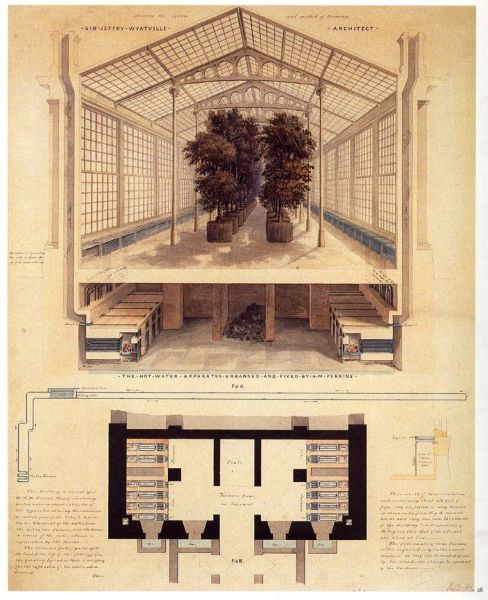
The Institute of Languages, Cultures and Societies (ILCS) at the School of Advanced Study, University of London (Senate House, Malet Street, London, UK) recently shared a call for papers for an international in-person conference to take place from September 16 through 17, 2027: Sensing the Hothouse: Innovative Approaches to a Cross-Cultural Literary Theme. The deadline for submission of proposals and bios is January 4, 2027.
Description: This interdisciplinary conference seeks to recontextualise the literary theme of the hothouse as a space of sensory experience. It brings together scholars from Literary Studies and a range of other disciplines that are interested in salient features of the hothouse as an actual or imagined space of perception, feeling and action. We invite papers on literature from scholars in English, German, French, Italian, Portuguese, Spanish, Latin American, and Caribbean Studies, which may explore new approaches or apply established methods to neglected cases. We also welcome papers on experiential qualities of material or imaginary hothouses from Art, Architecture and Cultural History, Environmental Humanities, History of Science, Philosophy, Performance Studies, Sensory Studies, Horticultural Technology, Botanical History and other pertinent fields.
Historically, hothouses, conservatories, orangeries, and winter gardens transformed relationships between plants, climates, and human culture. They enabled the cultivation of exotic species, participated in histories of botanical collecting and imperialism, and became spaces of display, scientific experimentation, domestic leisure, and social distinction. Glazed spaces such as the large-scale public hothouse, the smaller private greenhouse, the bell-jar or the aquarium reflected the nineteenth century’s vogue for science and spectacle. Putting safe borders on the unknown, they offered the chance to experience a foreign world in a safely contained way. The hothouse was entertainment and education, symbolized the extensive power and superiority of western colonial culture over distant zones, and was a world within a world within a world, a miniature theatre of the sublime.
In literature and the arts, hothouses have been associated with luxuriance, artificiality, decadence, eroticism, enclosure, excess, and desire. They have also offered distinctive environments in which questions of gender, class, health, beauty and the boundaries between nature and culture can be explored. The sensory dimensions of the hothouse are equally compelling. Heat, humidity, fragrance, colour, texture, sound and altered light produce an environment that acts upon the body before it is intellectually apprehended.
Hothouses therefore invite us to consider how they are experienced, and how and to what effect this experience can be depicted. What does it mean to read a hothouse atmosphere? How might literature evoke temperature, moisture, or scent? How do glass and transparency reorganise vision? What forms of touch and desire emerge around cultivated plants? In what ways can plants themselves be understood as participants in sensory and cultural worlds? How are material and symbolic understandings of the hothouse or human and more-than-human perspectives linked?
We particularly welcome papers that put disciplines, methods or forms of knowledge into dialogue. For example, what happens when Literary Studies encounter Architectural History, Sensory Studies encounter Botany, Environmental Humanities encounter Aesthetic Theory, or the History of Science encounters Poetry and Fiction?
Possible themes include:
- Hothouse histories: conservatories, glasshouses, orangeries, winter gardens and botanical gardens
- Plants and empire: colonial botany, plant collecting, transplantation, extraction and commodity culture
- The sensory hothouse: smell, touch, taste, sound, colour, heat, humidity and altered light
- Bodies and atmospheres: affect, embodiment, illness, vitality, desire and environmental exposure
- Hothouse aesthetics: decadence, aestheticism, symbolism, modernism and the cultivated flower
- Glass and vision: transparency, reflection, display, spectacle and surveillance
- Architecture and environment: enclosure, interiority, artificial climates and environmental technologies
- Gender and domesticity: the conservatory, garden, greenhouse and gendered spaces
- Art and representation: painting, photography, film, installation, sculpture and botanical illustration
- Literary hothouses: poetry, fiction, Gothic, modernism, children’s literature, speculative fiction and climate fiction
- Cultivation and artificiality: nature, technology, domestication and the production of life
- Plant agency and vegetal life: plants as objects, subjects, actors or collaborators
- Atmosphere and affect: Stimmung, ambience, environment and immersion
- The hothouse and the Anthropocene: greenhouse gases, climate change and planetary imaginaries
- Future hothouses: controlled environments, ecological futures, space travel and speculative worlds
- The hothouse as method: what can the hothouse reveal about interdisciplinarity itself?
We invite 300-word proposals for papers of 20 minutes length and a brief bio (max. 100 words). Please send to reach both organisers by 4 January 2027.
For more submission details, visit https://ilcs.sas.ac.uk/news-events/events/cfp-sensing-hothouse-innovative-approaches-cross-cultural-literary-theme
For inquiries about submissions, contact the organisers Jane Desmarais (jane.desmarais@sas.ac.uk) and Frank Krause (frank.krause@sas.ac.uk).
[Image above: Detail from an 1836 illustration by Sir Jeffry Wyatville of the Architectural Conservatory at Kew Gardens, renovated by Wyatville using A.M. Perkins’ high-pressure hot water boiler (via Wikimedia Commons/public domain).]