
Tiago Rogero and Daniela Díaz write about Colombia’s San Andrés and Providencia for The Guardian (US Edition). They say that at least 16 fishers from the region have gone missing since January after US began attacking boats in Caribbean and eastern Pacific.
Officially, the islands of San Andrés and Providence belong to Colombia – but the language spoken by most of the local Afro-descendant population is not Spanish.
Walking among brightly painted wooden houses raised above the ground and lined with verandas – architecture more reminiscent of the Caribbean and the southern US – the language most commonly heard is Creole, a distinct variety of Caribbean English. Yet the same emerald waters that provide fish for local communities and attract tourists from around the world have become “mass graves” for local fishers.
Because of the islands’ strategic location north-west of mainland Colombia between South and North America, young seafaring-skilled men have for years been recruited by groups moving cocaine produced in Colombia northwards, often as far as the US. They are members of the Raizal people, shaped by different waves of settlement over the centuries, but above all, defined by their African heritage.
Although the involvement of young Raizal men in drug trafficking is not new, residents agree it is growing and has acquired a dramatic dimension since the US began bombing speedboats allegedly carrying drugs in the Caribbean and the eastern Pacific. The airstrikes have killed 215 people since September in what the UN has condemned as “extrajudicial killings”.
At least 16 fishers from San Andrés and Providence have gone missing since January, according to Edgar Jay Stephens, 58, the president of the main local association of fishers, I-Fish. He said some of them might have been carrying drugs, but “certainly” not all.
The disappearances have also been a decades-long problem on the islands – whether because the men were killed, arrested by other countries or fell victim to harsh conditions at sea – but Stephens said the current pace was unprecedented. [. . .]
The sister of one of the 16 missing men said her brother had been trafficking drugs alongside two other Raizal men. “He accepted the job because it was easy money and he wanted to buy a plot of land and build a house,” said the sister, who asked not to be identified.
When she saw the news of a US airstrike on a speedboat carrying three men near Costa Rica, she sent his documents to Colombia’s embassy in the neighbouring country, hoping he might be identified among the three. He was not.
Meanwhile, Raizal fishers point to another consequence of the attacks: a direct impact on their livelihoods, as has happened in other traditional communities across the region. [. . .]
The islands of San Andrés and Providence lie closer to the coast of Nicaragua – 260 miles (420km) away – than to mainland Colombia, which is 450 miles distant.
After being initially claimed by Spain, they were permanently settled when English Puritans arrived in 1629. Pirates also passed through, and although Spain later reasserted control, it did not expel the English settlers. Enslaved Africans were subsequently brought to work on plantations, particularly cotton estates.
Following Colombia’s independence, the islands agreed to become part of the new nation. But it was only from 1912 onward that the state began to exert significant influence, imposing Catholicism and Spanish as the official religion and language in place of Protestantism and Creole.
To this day, however, many Raizales prefer to call Providence by its older name rather than the official Spanish one, Providencia. “I would say that the Raizal people are trilingual. We speak English, Spanish and Creole,” said the political scientist Sally Ann García Taylor, who was born in San Andrés and whose mother is from Providence. The Raizal people, she said, were the product of the interactions between all the peoples who had passed through the islands, although “Afro-descendant heritage is a major element in the formation of our identity”.
Another profound change came in 1953, when the government declared San Andrés a freeport – exempting imported goods from taxes – and encouraged large-scale migration from mainland Colombia.
The impact is still felt today in the island’s overcrowding. San Andrés, whose airport has daily flights to Bogotá and even Panama, covers 26 sq km (10 sq miles) and is home to 56,000 people. Providence, which has flights only to the neighbouring island, spans 17 sq km and has just 6,000 residents. Many local people say that, with its lack of hotels, fancy restaurants and duty-free shops, it is “like San Andrés 50 years ago”. The difference is also reflected in the islands’ ethnic makeup: while Raizales account for about 91% of Providence’s population, they now make up only 35% of San Andrés’s.
The contrast is also visible in the architecture. Providence, although still recovering from Hurricane Iota, which devastated more than 90% of its infrastructure in 2020, has largely preserved its traditional Caribbean architecture, while in San Andrés it is largely confined to the island’s southern areas, where most Raizales live. [. . .]
For full article, see https://www.theguardian.com/world/2026/jul/25/colombian-islands-san-andres-providence-fishers-us-strikes-boats
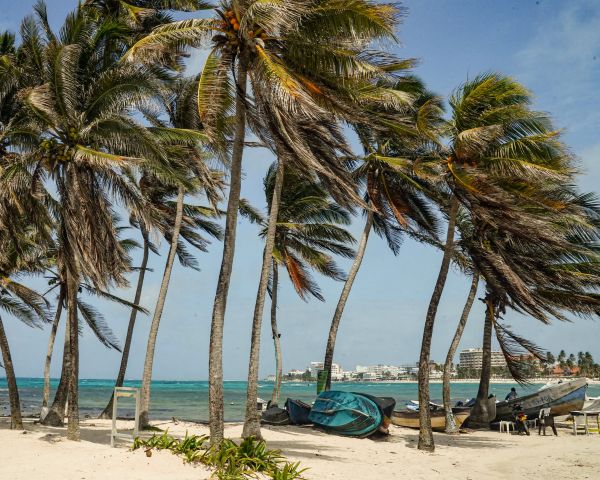
[Shown above, photo by Daniela Díaz/The Guardian: A beach on San Andrés island.]