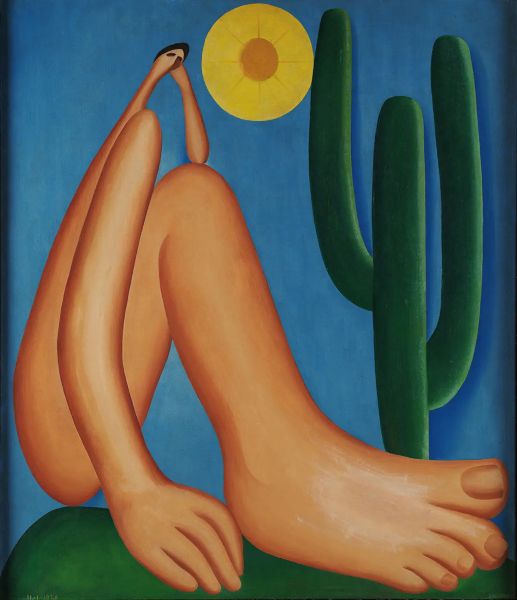
[Many thanks to Veerle Poupeye (Critical.Caribbean.Art) for bringing this item to our attention.] Art historian Sofía Cándano (Aeon) examines the trajectory and work of Brazilian thinker and poet Oswald de Andrade (and his 1928 Manifesto Antropófago) his wife, artist Tarsila do Amaral; anthropophagy and Brazilian modernism to introduce the reader to their legacy and influence over other artists of the Americas. Cándano explains, “Rooted in Brazilian modernism, anthropophagy devours and transforms culture, subverting colonial fears of cannibalism.”
Here we provide excerpts, with a section on two of our favorites— Cuban artist Wifredo Lam and Martinican thinker Frantz Fanon.
‘Antes dos portugueses descobrirem o Brasil, o Brasil tinha descoberto a felicidade,’ or ‘Before the Portuguese discovered Brazil, Brazil had already discovered happiness.’ So wrote Oswald de Andrade in his Manifesto Antropófago (1928), shifting the point from which history is told, and challenging a foundational assumption that colonialism had made to feel like common sense: that European culture was the natural standard against which everything else should be measured. That idea had shaped Brazilian intellectual life for generations. Andrade’s manifesto refused that premise. Not through rejection or imitation, but through transformation. [. . .]
Anthropophagy – cannibalism – had long been used to mark Indigenous peoples as savage and uncivilised. Andrade seized the accusation and turned it into a principle. But the principle had a specific logic. Indigenous practices of anthropophagy were not indiscriminate – they were strictly ritualised, selective. Only certain enemies were consumed, and only certain parts, in what Andrade described as the ‘absorption of the sacred enemy’. [. . .]
Anthropophagy was never a unified school followed by all. It was a shared disposition spreading across Brazilian modernism, linking experimentation in painting, poetry, music and criticism through the question of how to transform inherited forms rather than merely repeat them.
The gesture would not remain in Brazil.
In the work of the Cuban painter Wifredo Lam, the same impulse finds different ground – shaped by another history of encounter, between Europe, Africa and the Caribbean. A contemporary of Andrade’s, Lam studied in Spain in the 1920s, encountering the canon in its most institutional form. At the Prado, he studied Velázquez and Goya with discipline and intensity. But something felt missing. He later recalled the experience as being invited to an extraordinary banquet ‘where they did not give me what I wanted, what rightfully belonged to me.’ The metaphor is telling. Moving through Madrid and Paris, Lam encountered Matisse, Miró and the circle of Surrealism – studying their languages and ways of seeing. As with Andrade and Amaral, what he absorbed, he also altered.
Alongside his academic training, Lam carried another inheritance: Afro-Cuban spiritual traditions, the presence of ritual, the sound of drums, the dense vegetation of the Caribbean landscape. In Europe, he encountered African art again – but mediated, displaced, classified as ‘primitive’ and set apart from the so-called canon. In this displacement, he recognised something of his own history.
When Lam returned to the Caribbean in the early 1940s, he began to paint differently. In La Jungla (1943), human figures dissolve into vegetation. Limbs become stalks of sugarcane; faces elongate into mask-like presences; bodies fragment and recombine. The boundary between human, animal and plant is no longer stable. The painting draws on the formal languages Lam has absorbed – Cubist fragmentation, Surrealist distortion – but reshapes them through memory, ritual and landscape. His mask-like faces, the steatopygian figures whose bodies Western anthropologists turned into a category of deviance, are not simply stylistic gestures but carriers of memory and resistance. They unsettle the viewer by sustaining the tension, while opening up other ways of seeing, and of being.
Writing in Black Skin, White Masks (1952), the Martinican thinker Frantz Fanon described the pressure placed on the colonised subject to assimilate into the culture of the coloniser: ‘Le colonisé se sera d’autant plus échappé de sa brousse qu’il aura fait siennes les valeurs culturelles de la métropole… Il sera d’autant plus blanc qu’il aura rejeté sa noirceur, sa brousse.’ (‘The colonised is elevated above his jungle status in proportion to his adoption of the mother country’s cultural standards. He becomes whiter as he renounces his blackness, his jungle.’) Lam’s work refuses such terms, imposed on the ‘savage’ or exotic ‘other’. ‘My painting,’ Lam would later say, ‘is an act of decolonisation – not physical, but mental.’ [. . .]
For full article, go to https://aeon.co/essays/anthropophagy-art-flips-the-cannibal-worries-of-colonialism
[Shown above, photo by Romulo Fialdini and courtesy MALBA, Buenos Aires/Wikipedia: Abaporu (1928) by Tarsila do Amaral.]