
Here is a call for papers for the next issue of liquid blackness: journal of aesthetics and black studies (vol. 10, no. 2, Fall 2026)— “Caribbean Metamorphosis,” guest edited by Christina León, C.C. McKee, and Judith Rodríguez. The deadline for submissions is September 15, 2025. [The liquid blackness project is a nonprofit research group collaboratively studying blackness and aesthetics. (Many thanks to Peter Jordens for bringing this item to our attention!)]
Description: The Caribbean has a tense relationship to the aesthetic because of how its islands, geopolitics, and history have been overlaid by colonial and tropicalizing discourse. In his third attempt at circumnavigating the planet, Christopher Columbus modified the Ptolemaic theory of the spherical earth to render it in the form of a pear or of a feminine breast with the Caribbean as the nipple and, thus, closer to heaven. This Columbian aesthetic ideology of an Earthly Paradise hovers over the Caribbean both historically and within our contemporary moment wherein shorelines function primarily for speculative finance and the tourist industry. This violent beauty creates ideal postcards that transmogrify the Caribbean as a zone of resource and respite for the Global North. And due in part to this gendered, colonial violence of Columbian visions, the Caribbean has also produced writers, theorists, visual artists, critics, filmmakers, historians, and musicians who have cannibalized and transformed this aesthetic overlay in brilliant ways, asking us to look again at what “beauty” itself may hide. The undeniable beauty of the area is considered in tandem with the problem of beauty in these islands in Suzanne Césaire’s writing in Tropiques; as well as Jamaica Kincaid’s writing in A Small Place; in the literary production of authors like Marie Vieux Chauvet and Tiphanie Yanique; in the visual art practices of artists like Wifredo Lam; in the performances of María Magdalena Campos Pons; and with the expansive festival arts of carnival.
Given this legacy of the Caribbean grappling with the aesthetic, the guest-editors of “Caribbean Metamorphosis,” a special issue of liquid blackness: journal of aesthetics and black studies, are calling on artists, critics, and theorists to contribute publishable efforts of rigorous, experimental, scholarship, including visual portfolios, musical playlists, film criticism, music writing, and other representative works of dynamic, inventive black study. We take this special issue title from Sylvia Wynter’s unpublished manuscript “Black Metamorphosis,” which traces the ontological transformation of Africans in the New World condition by, but decidedly not limited to, colonial enslavement. She describes a process of Black “indigenization” in the Caribbean not as a replacement for the Indigenous peoples of the Archipelago, but as an ontic process of being-in-place by making kin within social strictures that would preclude blackness from these forms of being human. In this issue we welcome submissions that may contend with the complications and possibilities Wynter delineates through and from the Caribbean.
Contributions might begin with interrogating what Kamau Brathwaite calls the “inner plantation” and his “inclination” to think of Caribbeanness as deriving from “the cores and kernels; resistant local forms; roots, stumps, survival rhythms” that structure blackness materially and aesthetically. Elsewhere, Sylvia Wynter offers another valence of the “inner plantation” with her novel, provocative, psycho-social framing of black experience as revealed in the life and afterlives of the Jonkonnu festivals of Jamaica. This Caribbean intellectual entanglement impels us to scale out this blackness and read the Caribbean as an aesthetic knowledge project of black space.
Brathwaite and Wynter centralize artist-theorists in the Caribbean intellectual tradition, reading its diasporas in its geopolitical sedimentation within the figural and material violence of African slavery and indigenous genocide. And because of its tense relationship with Global North/North American epistemologies and aesthetics, as well as its allegorization by Latin American eugenic discourse, the guest-editors are seeking pieces that–rather than reifying those recognizable narratives and practices–complicate or turn away from them altogether. Following Rinaldo Walcott’s critique of U.S. Black Studies’ interpretation of Caribbean studies as a geo-relational category because of its pluralism, we desire efforts that reject “creolization” as a philosophical suture to both the “romance” of “Plantation-America” and the “biology” of “diversity.” We do this in favor of delineating discursive avenues where, without subordination, Caribbean studies center a practice of black study.
We encourage submissions in a range of formats including essays, visual dossiers, and other creative aesthetic formats that may address, creatively respond to, as well as add to the following:
- Indigenization
- Afro-Caribbean Cosmologies and Non-Linear Temporalities
- Black Ecological Entanglements (beyond disaster)
- The Caribbean as Unbounded Space
- Caribbean Aesthetic Strategies (opacity, camouflage)
- Caribbean Aesthesis in Diaspora
- Caribbean Legacies of Fascism and Resistance
- Figurations of Beauty and Violence in the Caribbean
- Caribbean Modalities of Non Sovereignty
- Archipelagic Envisioning or Figuring Caribbean Thought in Transit: The Figures and Conceptual Travel of Caribbean Thinkers
- Caribbean Underclasses
- Translation and the Afro-Caribbean
- “Cric? Crac!” Narrative and the Ancestral
- Créolisation, Antillanité, and Unity in Diversity
- Philosophical Negativity in the Tropics
For complete guidelines, see https://liquidblackness.com/news?category=CFPs
Please submit at: https://mc04.manuscriptcentral.com/dup-lbk
Contact: journalsubmissions@liquidblackness.com
https://liquidblackness.com/news/liquid-blackness-issue-102-cfp-caribbean-metamorphosis
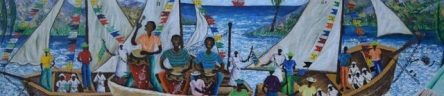
[Shown above: Detail from artwork at https://liquidblackness.com/curating-for-blackness-1]