
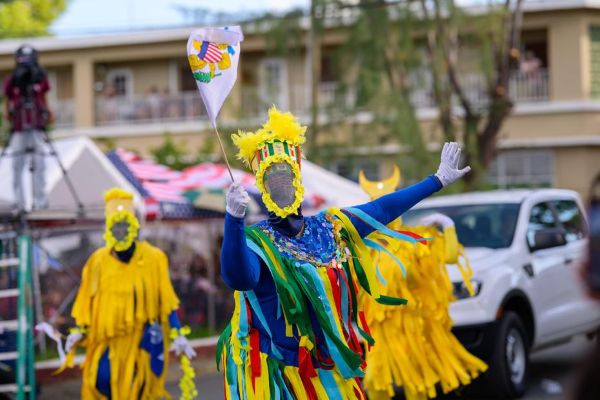
Here we share just a few excerpts of Stephanie Chalana Brown’s well researched article on the history and importance of masquerading and carnival traditions in the U.S. Virgin Islands (USVI) for Smithsonian Folklife Magazine (26 August 2026). Ms. Brown is the director of the Division of Virgin Islands Cultural Education at the V. I. Department of Education and the artistic director of Keeping Masquerading Traditions Alive as well as the Sanctuary Festival Troupe. Her work centers on building educational experiences that reflect the histories, voices, and contributions of Afro-Caribbean communities. Read the full article, with photographs of masking through the years at Smithsonian Folklife Magazine. [Many thanks to Peter Jordens for bringing this item to our attention.]
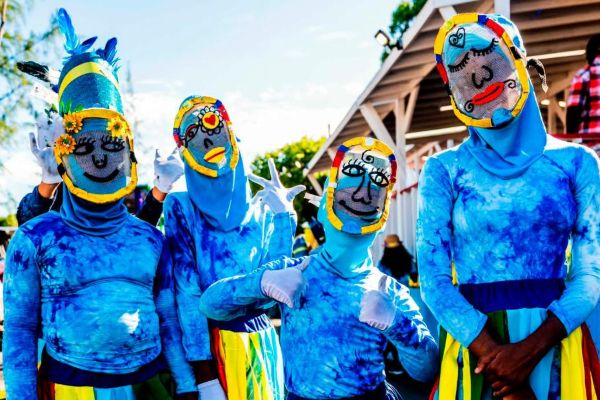
Today, when masqueraders move through the streets of the U.S. Virgin Islands—a territory that includes the Caribbean islands of St. Thomas, St. Croix, and St. John—many people no longer recognize the tradition.
A few years ago, this realization hit me profoundly, and it inspired me to help create the Keeping Masquerading Traditions Alive initiative, a contemporary effort dedicated to documenting, practicing, discussing, and transmitting masquerading traditions within USVI. [. . .]
Although these islands became part of the United States in 1917 through the transfer of the former Danish West Indies from Denmark, the cultural traditions that define Virgin Island life emerged through centuries of creolization, producing new languages, customs, forms of artistic expression, and identities.
Among the most enduring of those traditions is masquerading, a cultural practice that offers insight into performance, celebration, cultural continuity, and the emergence of identity within the Caribbean while enriching the cultural diversity of the United States as a whole. Masquerading is the act of dressing in elaborate costumes—and often masks—to perform and parade through the streets during various seasonal festivals, such as the Crucian Christmas Festival on St. Croix, the Virgin Islands Carnival on St. Thomas, and the St. John Celebration.
The story of masquerading in USVI reveals how people living in the former Danish West Indies transformed influences from Africa, Europe, and the wider Caribbean into cultural expressions rooted in their own experience. African traditions existed alongside those brought by British, Irish, Scottish, Danish, and other communities that shaped life in the islands, and the creolized character of Virgin Islands masquerading is evident in the tradition itself.
Long before Africans were brought to the Caribbean, many West African societies practiced masking, drumming, dance, and public procession as part of community and spiritual life. Practitioners today often note similarities with traditions like the Yoruba Egúngún festival of present-day Nigeria and Benin.
By 1733, St. Croix, St. Thomas, and St. John had become the principal islands of the Danish West Indies, a plantation colony sustained through the labor of enslaved Africans and their descendants. Many planters were English and many overseers Irish and Scots Irish. These communities brought their own seasonal masking traditions, including English Christmas mumming, Scottish guising, and Irish Wren Day parading.
“Our ancestors adapted European customs to our African cultural traditions of masquerading,” historian Karen Thurland says.
Through generations of encounter, exchange, resistance, and cultural creation, these African and European threads wove into a creolizing process that produced distinct Virgin Islands identities, traditions, and ways of belonging. [. . .]
In a place once associated with attempts to suppress public celebration, residents now celebrate, teach, remember, and participate.
The revitalization of traditions by the Crucian Cultural Group reflects a longer history of community stewardship. That same commitment informs our Keeping Masquerading Traditions Alive initiative.
The initiative emerged from recognizing that opportunities to encounter and learn traditional masquerading have become increasingly limited outside of major Festival and Carnival celebrations. Through oral histories, public discussions, drumming workshops, movement instruction, performances, archival research, and intergenerational learning, participants engage masquerading as a living cultural practice and a vehicle for understanding the emergence of Virgin Islands identities.
One of the initiative’s most significant gatherings was a public roundtable in October 2025 titled “Masked Memory .” The discussion brought together culture bearers, scholars, musicians, dancers, and community members to explore the Carnival characters of Baby Doll, the Bulls, Mother Hubbard, Pitchy Patchy, and the Clowns of St. Thomas while also examining larger questions concerning ancestry, identity, creolization, and cultural continuity.
“People cannot inherit traditions they rarely encounter,” I stated during the event. “Our goal is to create opportunities for communities to engage the history, music, movement, stories, and identities carried by masquerading so that future generations recognize the tradition, understand its significance, and see themselves within its story.” [. . .]
For full article and photos, go to https://folklife.si.edu/magazine/virgin-islands-masquerading-traditions