
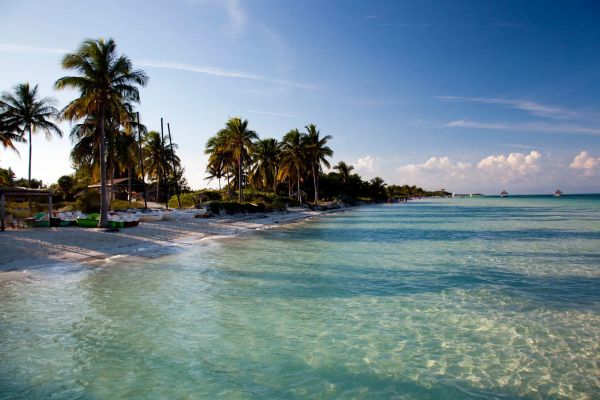
David C. Adams (The New York Times, 30 August 2026) reports on lawsuits against Expedia regarding land in Cuba for failing to obtain permission from original landowners when renting out rooms in hotels there: “The latest trial against Expedia involves bookings at four other hotels on Cayo Coco as well as the San Carlos Hotel in Cienfuegos, on Cuba’s south coast. All had been operated by a Spanish hotel chain, Meliá, which quit Cuba this summer. Although the chain did not cite U.S. sanctions as a factor, experts said they most likely contributed to the decision.” Cayo Coco is described as “a stretch of pristine beaches, hundreds of miles from Havana and home to a dozen modern hotels. [. . .] Ordinary Cubans who do not work in the hotel sector [. . .] are forbidden entry to the cay.”
Little did Mario Echevarria know, growing up, that the site of his father’s cattle and business on a cay north of Cuba would one day become a jewel in the Communist island’s tourism industry.
Now 91, stooped and gray-haired, Mr. Echevarria is seeking damages against Expedia Group, the travel booking giant, for failing to obtain his permission when reserving rooms in hotels built on Cayo Coco, land confiscated from his family in 1960.
Testifying in Miami federal court last week, he was asked who authorized the bookings.
“That was given to them by the dictatorship,” he said.
The civil trial is the second in the past 18 months against Expedia, whose lawyers argue the company believed it was acting legally. The claims stem from a section of a 1996 law that lets U.S. citizens — including Cubans who were not Americans at the time — accuse companies of having illegally “trafficked” in assets seized without compensation.
Expedia entered Cuba in 2017, after President Barack Obama issued new rules letting American hotel chains operate there.
The lawsuit is one in a surge by Cuban families making claims over confiscated assets, dating back to the beginning of the Cuban Revolution in 1959, and comes as President Trump intensifies a pressure campaign on the island.
These claims pit the historical demands of Cuban exiles against the interests of corporations that have tried to navigate the island’s market amid volatile U.S. policy. During his second term, Mr. Trump has oscillated between wanting to work with Cuba’s government and developing plans to overthrow it, all while expanding sanctions.
Mr. Trump took a hard-line stance toward Cuba in his first term, including by opening the door to the current lawsuits. He did that by ending a decades-long suspension of part of the 1996 law, the Helms-Burton Act, which Cuba calls an assault on its sovereignty. Since then, the law has been used to sue various businesses, including cruise lines, energy companies and mining operations.
Forty to 50 lawsuits have been filed in U.S. federal courts, legal experts note, with cases reaching the Supreme Court. [. . .]
The latest trial against Expedia involves bookings at four other hotels on Cayo Coco as well as the San Carlos Hotel in Cienfuegos, on Cuba’s south coast. All had been operated by a Spanish hotel chain, Meliá, which quit Cuba this summer. Although the chain did not cite U.S. sanctions as a factor, experts said they most likely contributed to the decision.
The families seek damages calculated to the market value of the properties, collectively estimated at $82 million. [. . .]
On the stand, a former Expedia manager, Veronica Cassano, said her superiors never instructed her about the Helms-Burton law. She described meetings with high-level Cuban officials and said she did not have any conversations with Expedia about Cayo Coco’s historical ownership. [. . .]
For full article, see https://www.nytimes.com/2026/08/30/world/americas/cuba-expedia-lawsuit.html
[Photo by Phil Clarke Hill/Corbis, via Getty Images: “A beach on Cayo Coco island in Cuba. Land on the cay, off Cuba’s north coast, was seized decades ago by Cuba’s Communist authorities and eventually developed for tourism.”]