
[Many thanks to Elidio La Torre Lagares for bringing this item to our attention.] Amann S. Mahajan reports for The Chronicle of Higher Education about “The University that answers to the U.S. President,” the University of Puerto Rico: “Public funding has tumbled. Governance is in crisis. And who’s really in charge is up for debate.” Here are excerpts; read full article at The Chronicle.]
A near-$700-million deficit: the stuff of actuarial nightmares, and the grim specter presiding over a recent University of Puerto Rico Governing Board meeting. The vote that day in April, on a plan to shore up the struggling university system, split along predictable fault lines. Faculty and student representatives rejected what they saw as a half-baked proposal. The Puerto Rican governor’s appointees, more closely aligned with the university administration, approved it. But the most important player was not in the room: a seven-member body appointed by the U.S. president, the ultimate arbiter of university fiscal plans and budgets, tasked not only with erasing this deficit but with restructuring the entire commonwealth’s immense debt.
That was a problem — because no one seemed to understand exactly what path the federally appointed board wanted the university to take.
“I would like to know: Who will be the person on the [presidential] board who will be following up on this crucial issue?” Julio A. Cabral Corrada, a Governing Board member, asked in remarks translated from Spanish. “Who are the advisers? McKinsey? Ernst & Young? [. . .]
In May, the U.S. presidential appointees rejected the university system’s fiscal plan and subsequently imposed their own.
A handful of financially unstable public colleges have recently seen governments descend for damage control. [. . .] But the University of Puerto Rico, an 11-campus system known as UPR, is sunk in a deeper quagmire, and the intervention isn’t coming from its own elected officials. Here, higher-education appropriations have dropped dramatically — by more than a third, per some calculations — amid the island’s economic challenges. The demographic cliff has hit harder there than on the mainland. Accreditation woes have loomed. Meanwhile, a struggle over institutional governance has intensified. Nearly half of the campus chancellors were removed this year. Dayslong student strikes have upended teaching and learning.
At the crux of the crisis is a question that has lingered for a decade now: Who actually runs the University of Puerto Rico?
When President Trump selected Antonio Medina to serve on Puerto Rico’s Financial Oversight and Management Board in 2020, the longtime financial manager was honored to take the role. Still, Medina had mixed feelings about the board, known as the FOMB, which he said served as an uncomfortable reminder of U.S. colonization. “From an emotional standpoint, I can say, yes, I don’t like the fact that Puerto Rico has a board,” Medina said. But, he added, he understood “the function of the board, which is to have nonpolitical people involved in resolving the fiscal matters and the issues related to bankruptcy that were created by elected officials.” In 2015, the Puerto Rican government declared its debt unpayable; the next year, the U.S. enacted a law granting final jurisdiction over the island’s budget to the FOMB.
Since then, UPR’s fate has been wrapped up in an age-old debate: To what extent should public higher education rely on government support?
UPR’s historic legislative appropriation, roughly 60 to 70 percent of its budget, hearkens back to a time in U.S. higher ed when states provided most of public colleges’ funding. In Puerto Rico, that support was enshrined in law. A 1966 statute allocated 9.6 percent of the commonwealth’s general-fund revenues to the university.
The FOMB first reduced government contributions to UPR by about $200 million in the 2018 fiscal year. And the cuts kept coming, cutting into more than a third of UPR’s original support by fiscal year 2021.
The FOMB made the cuts partially to nudge the university toward alternative sources of revenue — a scheme that’s resulted in the system’s budget, excluding federal funding, declining by around 10 percent since the FOMB arrived, according to data provided by the FOMB to The Chronicle.
Some have said the cost is too high: UPR has nearly tripled tuition rates, from roughly $57 per credit in 2017 to $157 per credit in 2023. About two-thirds of students at the flagship Rio Piedras campus are eligible for Pell Grants, but they’re now using up more of those grants on the higher sticker price — leaving less behind to pay for housing, meals, and other materials. Private dollars haven’t been a robust option; UPR doesn’t have strong alumni networks, and the flagship spent down much of its $1.9-million endowment in the 2024 fiscal year.
At the same time, the university system had to adjust for a demographic cliff far more extreme than those at U.S. mainland colleges: Birth rates in Puerto Rico — which have been lower than the national average for more than 20 years — have declined precipitously, as has overall K-12 enrollment. [. . .]
In 2025, Zayira Jordán Conde became the fourth person to lead the system in the past five years. Conde inherited both long-term fiscal woes and a new blitz of federal funding cuts, including an estimated $8-million loss in grants for Hispanic-serving institutions. (She was also faced with a newly unsteady FOMB; Trump dismissed most members months into his second term.)
“The political shuffle of administrators at higher levels in the University of Puerto Rico, I would venture to say, is much more drastic and volatile” than at most U.S. colleges, said Isar Godreau, a researcher at UPR’s Cayey campus and one of the authors of the 2021 AAUP journal article on UPR.
Less than a year into Jordán Conde’s tenure, there was even more shuffling. In March, Jordán Conde announced the removal of five of UPR’s campus chancellors, citing a need for stability and institutional efficiency. The dismissals and new appointments were in line with “institutional transformation” measures that required administrative changes, she told El Nuevo Dia, an island-based news outlet — drawing on language from the UPR office tasked with fulfilling the FOMB’s efficiency benchmarks. [. . .]
The decision amplified concerns raised during Jordán Conde’s selection process. Professors and students saw her as a political appointee anointed by Gov. Jenniffer González-Colón, a Republican and Trump supporter. Jordán Conde, who had served on the governor’s transition team in 2024, had led a private college in Puerto Rico. But many feared she lacked the knowledge to navigate UPR’s unique challenges; academic senates at nine of the 11 campuses did not recommend her for the job.
Within months, the battle lines hardened. The faculty union accused Jordán Conde of slow-walking negotiations. By February, faculty and students on the system’s governing board had already called for her to be removed, and the advisory University Board withdrew confidence in her, saying she failed to meet her job’s responsibilities. Then came the chancellors’ dismissals. [. . .]
While the FOMB doesn’t have the authority to dictate UPR’s internal governance structures, it remains the éminence grise shaping the university’s internal responses to a financial crisis. And the university must reform itself, Bill 1256 argues, to better confront its budget.
(The spokesperson for UPR’s governing board said the board and president’s office had not determined an institutional position on the bills as of yet, adding that they would have to consider accreditation implications and governance principles. The FOMB spokesperson said the body would only weigh in on the bills’ fiscal impact once they had wound through the legislature and the governor submitted them to the fiscal board for review.)
Other groups have expanded on the FOMB approach, urging further consolidation of core services at the main campuses. “Autonomy is not granted. It is earned,” Birling Capital Advisors, a consulting firm, wrote in a May report detailing a 15-year, three-phase plan to reform the university. [. . .]
For full article, see https://www.chronicle.com/article/the-university-that-answers-to-the-u-s-president
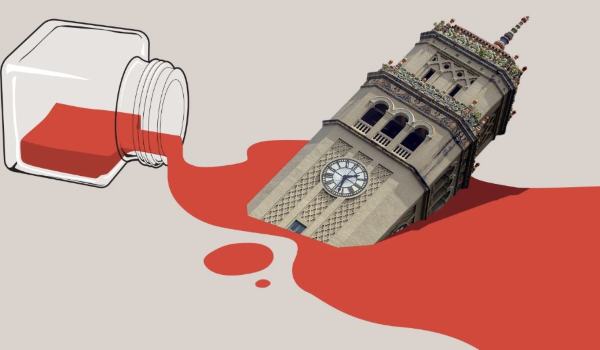
[Shown above: “Puerto Rican Puzzle,” illustration by the Chronicle, Getty.]