
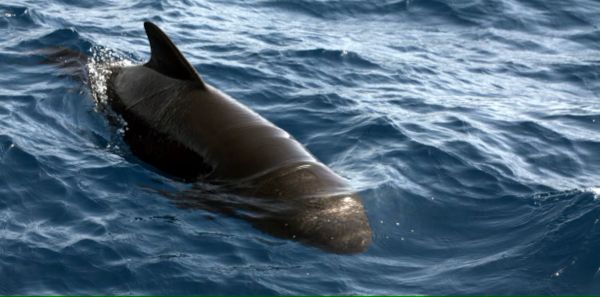
Andrea Guemárez Soto offers a review of the main characteristics, behavior, and distribution of pilot whales— marine mammals that belong to the dolphin family, just like dolphins and orcas—four of which have been seen stranded in Puerto Rican waters. Here is a series of excerpts from her recent article for El Nuevo Día (31 July 2026).
The four pilot whales that were stranded this Friday at Punta Santiago beach in Humacao belong to a species that inhabits Puerto Rican waters and usually travels in large, close-knit family groups. This has been the first reported pilot whale stranding on the island so far this year, confirmed Dr. Grisel Rodríguez, coordinator of the Marine Mammal Rescue Program at the Department of Natural and Environmental Resources (DRNA). But what distinguishes these marine mammals, where do they live, and why do they often experience mass strandings?
The Origin of Their Name
According to the International Whaling Commission (IWC) website, these animals received their name because it was once believed that each group was led by a “pilot” or leader.
Their scientific name, Globicephala, means “round head,” referring to their distinctive head shape. They are also distinguished by their dark color and a thick, curved dorsal fin, which is usually more pronounced in adult males.
Although they are known as whales, they belong to the dolphin family (Delphinidae), as do dolphins and orcas.
Two Species and Their Presence in Puerto Rico
There are two species of pilot whales: short-finned pilot whales, which are found mainly in tropical and warm-temperate regions, and long-finned pilot whales, which prefer cooler waters.
According to the International Whaling Commission, short-finned pilot whales are found both near the coast and in the open ocean. The organization includes Puerto Rico among the places where they are native or appear seasonally, along with other Caribbean territories such as the Dominican Republic, Virgin Islands, Bahamas, Cuba, Jamaica, Dominica, Barbados, Aruba, and Curaçao. They are also found in coastal and oceanic areas of countries such as the United States, Mexico, Brazil, Venezuela, Japan, the Philippines, Australia, and New Zealand.
Although many pilot whales are nomadic, resident populations have been identified in places such as the Canary Islands, Madeira, and Hawaii.
Meanwhile, long-finned pilot whales primarily inhabit cold, subpolar waters of the Southern Hemisphere. In the Northern Hemisphere, they are concentrated in areas near places such as Canada, Iceland, Norway, Ireland, the United Kingdom, Spain, France, and Italy. [. . .]
Excerpts translated by Ivette Romero. For full article (in Spanish), see https://www.elnuevodia.com/ciencia-ambiente/flora-fauna/notas/que-son-las-ballenas-piloto-y-donde-viven/