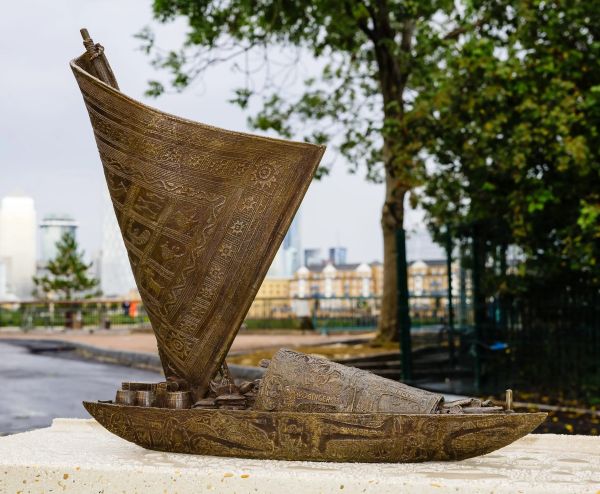
I have always been a fan of Hew Locke’s sculptural reimagining of boats, ships, and flotillas, so I was excited to read about this new unveiling! The artist writes, “At last! This project started before lock-down and has just been opened to the public. My six permanent bronze sculptures have been unveiled in the King Edward Memorial Park in Wapping, London. Titled ‘Cargoes’, they depict a Carrack, Tugboat, Thames Barge, Bangladesh river boat, Rubbish Barge, and a Chinese Junk, embellished with numerous different images and symbols, reflecting on the long history of the Thames and of Tower Hamlets. Commissioned as part of the Thames Tideway Tunnel project, the boats are mounted low, to encourage people to feel and interact with them.” Read Tideway’s full description below.
Description: Hew Locke was commissioned by Tideway to create a series of permanent public artworks for King Edward Memorial Park. The ‘cultural meander’ or heritage theme for the East section of the tunnel is The Shipping Parishes – Gateway to the World. Within this context, the site-specific narrative for King Edward Memorial Park centres on Sailortown, international diaspora and progressive politics.
In response to Tideway’s Heritage Interpretation Strategy (HIS), Locke developed a sculptural artwork drawing on the site’s close historical ties to mercantile and dock communities, and the far-reaching impact of Britain’s maritime power and trading empire on diverse ethnic, social, and economic groups, both locally and globally.
The completed artwork comprises a series of cast bronze boats, each referencing different periods, communities, and vessels historically associated with the Thames. Inspired by extensive research into the symbolic and cultural significance of ships – as vessels for travel, trade, and transformation, and as metaphors for human passage – Locke incorporated intricate decorative details and cargoes reflecting these layered histories.
His research process included consultation with local community groups – such as the Boitok Group (St Hilda’s East Community Centre), the Coriander Club (Spitalfields City Farm), and the Hermitage Community Moorings – as well as institutional partners like the National Maritime Museum and Museum of London. These conversations informed the inclusion of specific motifs and elements within the artworks.
The final artworks include a Tug, Chinese Junk, Flat Barge, Carrack, Thames Barge, and a Bangladesh River Boat – each a patchwork of the evolving identity of East London. Each vessel also carries numerous decorations, object and images referencing different histories and peoples who have used the Thames over the centuries from Celtic times. Ranging in scale (approx. 1000mm long and 300mm wide), the boats are placed on low plinths or integrated into the landscaping of the park, forming a trail that leads visitors toward the river. The sculptures are strategically positioned to be discovered at different levels and vantage points, offering moments of reflection and connection to the River Thames.
Fabricated in bronze using the lost wax process, the sculptures were developed by the artist in close collaboration with skilled fabricators. Full-scale models were made by Locke, capturing rich surface textures and detail. These were translated into bronze through a multi-stage casting process involving 3D printed patterns, rubber and plaster moulds, wax models, and detailed finishing work.
Cargoes form a powerful sculptural trail linking King Edward Memorial Park to the river, inviting audiences to engage with the layered histories of the Thames and the people who have travelled it.
For more information on the site’s history, see Tideway’s Heritage Interpretation Strategy.
The artist has said: “The boats are set low, as I want to encourage touching, curiosity and interaction – they are conversation pieces, and a landmark. Human figures are not depicted – you can imagine yourself aboard. In many cultures, ships are symbolic of a person’s passage through life and as a container of the soul. I have not created accurate models of boats, but sculptural re-imaginings, incorporating decoration and symbolism. The real cargo of these boats is the exchange of cultures, goods and ideas.”
For more information, see https://www.tideway.london/impact/art-on-the-tideway/permanent-commissions/hew-locke-cargoes/ and https://www.facebook.com/pages/King%20Edward%20Memorial%20Park/182720311749393