Nkgopoleng Moloi interviewed artist Remy Jungerman (1959, Suriname) for ArtThrob (25 March 2025). Here are the excerpts; to access the full interview, visit ArtThrob.
We reached out to artists whose work we admire and asked them about their artistic journeys, current projects and the ideas that drive their practice.
In this series, we spotlight the unique approaches of contemporary artists, offering them a platform to share insights into their artistic process, ongoing work, and the parameters that define their practice.

Remy Jungerman (1959) lives and works in New York and Amsterdam. He attended the Academy for Higher Arts and Cultural Studies in Paramaribo, Suriname, before moving to Amsterdam where he studied at the Gerrit Rietveld Academy. In his work, Jungerman explores the intersection of pattern and symbol in Surinamese Maroon culture, the larger African diaspora, and 20th-century Modernism. Placing fragments of Maroon textiles and other materials found in the African diaspora—the kaolin clay used in several religious traditions or the nails featured in Nkisi Nkondi power sculpture—in direct contact with materials and imagery drawn from more “established” art traditions, Jungerman presents a peripheral vision that enriches our perspective on art history.
Remy Jungerman (1959) lives and works in New York and Amsterdam. He attended the Academy for Higher Arts and Cultural Studies in Paramaribo, Suriname, before moving to Amsterdam where he studied at the Gerrit Rietveld Academy.
In his work, Jungerman explores the intersection of pattern and symbol in Surinamese Maroon culture, the larger African diaspora, and 20th-century Modernism. Placing fragments of Maroon textiles and other materials found in the African diaspora—the kaolin clay used in several religious traditions or the nails featured in Nkisi Nkondi power sculpture—in direct contact with materials and imagery drawn from more “established” art traditions, Jungerman presents a peripheral vision that enriches our perspective on art history.
1. I’m curious about what you’re currently reading, and how these texts, ideas, or theories might be influencing the way you think about your work.
I’m currently reading Dr. Kellie Jones’ collection of essays on David Hammons. I’ve always been intrigued by Hammons as an artist—how he used his cultural background to reflect Black Harlem in ways that were groundbreaking at the time. He once said, “You can’t live in Harlem and produce downtown art.” Living close to what he called “elemental things” about Black culture—dreadlocks and wine bottles, basketballs and bones, ice and air, rubber and stone—he protected himself from the constraints of the “white cube space” and the money-driven mindset. Hammons secured his artistic freedom through cultural openness. His approach stood in stark contrast to what artists in Lower Manhattan, particularly white artists, were doing, and that deeply resonates with me.
His attitude and artistic choices have influenced how I think about my own narratives and cultural background. Moving to New York as an artist from the African Diaspora has given me new energy, especially while reading Robert Farris Thompson’s essay in the book ‘David Hammons: Knowing Their Past’. When Thompson visited Hammons’ Harlem studio in 1992, he was struck by the materials Hammons used—ordinary objects found in the streets of Harlem itself. This made me reflect on what I bring into my own practice and how I can contribute to the art scene now—not as an African American artist, but as someone who comes from the African diaspora. My experience is different to other artists from the diaspora but we are all deeply interconnected. I often think how amazing it is that it was only by chance that my ancestors were enslaved and taken to Suriname instead of the United States during the transatlantic slave trade. In fact, this shared history creates links between Black communities across the Americas. I’ve been thinking a lot about the abstraction that originated on the African continent and how it spread throughout the diaspora—from the intricate geometric compositions of Maroons’ early 20th-century shoulder capes in Suriname to the quilts of the American South, especially those made by the women of Gee’s Bend. These connections continue to shape my work.
2. Your work is known for its well-defined compositions. How do you approach the placement of shapes and lines in your work? Is the composition guided by intuition, or do you follow a more deliberate, structured approach when deciding where each element fits within the surface?
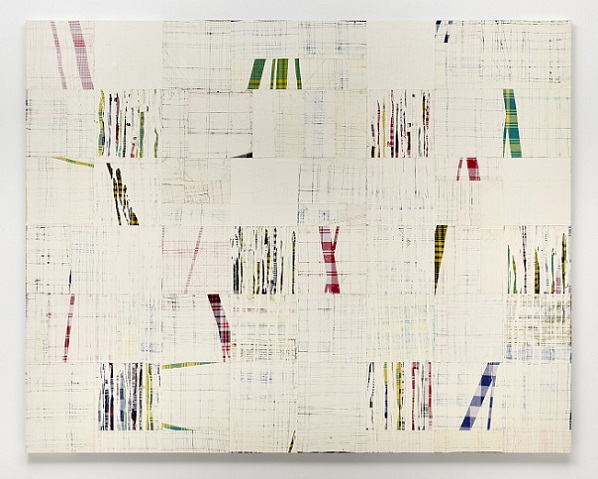
In my works, the grid is very important in the initial stages of building compositions. I draw inspiration from geometric compositions found in Maroon shoulder capes from Suriname and the quilts of the American South, especially those made by the women of Gee’s Bend. From there, I begin filling in the grid drawn on the panel with squares and rectangles of gridded textile, which have been layered with kaolin clay. The gridded textiles I use are often used in Suriname in Winti rituals. Winti is an Afro-Surinamese religious system. The textiles incorporate certain colour combinations that represent Winti’s 4 pantheons: water, air, forest, and earth. While much of the composition follows a structured approach, there are certainly moments where a kind of intuition takes over as I listen to whispers from my ancestors. In a sense, it is they who guide the process and shape the final artwork. [. . .]
Access the full interview at https://artthrob.co.za/2025/03/25/in-focus-five-questions-with-remy-jungerman/
[Shown above: 1) Pimba AGIDA SUSA V, cotton textile, kaolin (pimba) on wood panel (plywood), 2024, photographed by Anthea Pokroy; 2) Photo of Remy Jungerman by Bram Belloni.]