
Dánica Coto (AP News) writes about words from the English-speaking Caribbean that are now part of Oxford English Dictionary. She focuses mostly on words from Bermuda and Trinidad, such as bimpert, hornerman, jablesse, and douen, among others. [Many thanks to Peter Jordens for bringing this item to our attention.]
More than a dozen words long used in Bermuda and across the Caribbean got an official nod on Wednesday from the Oxford English Dictionary.
First in line is “bimpert,” a Bermudian word of unknown origin that is used to describe a stupid or foolish person. People on the tiny island in the north Atlantic often use it in this traditional phrase: “A bimpert is justah wuffless bye,” which roughly translates to: an idiot is just a worthless boy.
Another colorful addition is “hornerman,” a word used in the eastern Caribbean island of Trinidad and Tobago since 1975 to describe an unfaithful man or a man having a relationship with someone else’s partner. [. . .]
Among other dark words that made the list is “jablesse,” defined as “a malevolent shape-shifting female spirit with one cloven hoof, which at night is said to assume the form of a beautiful woman to lure men to their deaths.” It is derived from “diablesse,” the French word for female demon.
Another supernatural entry is “douen.” It is “typically depicted as short in stature, with backward-pointing feet, and wearing a large hat, said to be the spirit of a child who died before it could be baptized, and believed to lure children into the forest by calling their names,” according to the dictionary. It is a variation of the Spanish word “duende,” which means elf. [. . .]
Several food-related words were included this year: “shadeesh,” the Bermudian word for chorizo; “sugar cake,” made of grated coconut boiled with sugar, water and spices; and “peanut punch,” a wildly popular rich and frothy beverage made with peanuts or peanut butter, milk, sugar and several spices. [. . .]
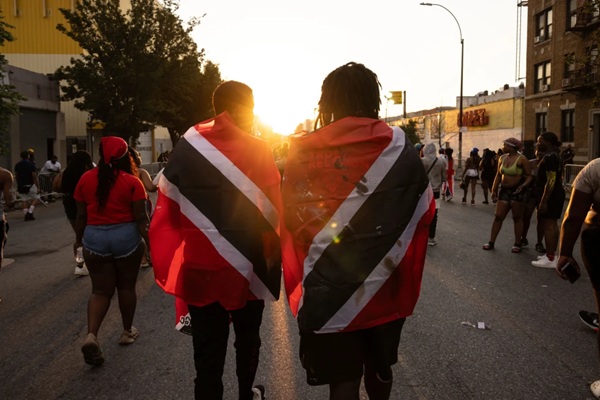
The final Caribbean English words added this year are “Trinbagonian,” which refers to people from both the islands of Trinidad and Tobago, and “canboulay,” which refers to Carnival festivities in Trinidad in the 1800s that celebrated the emancipation of slaves. They stem from a 1700s harvest festival that the British tried to quash, leading to riots reenacted to this day to mark the start of Carnival. Canboulay is derived from “burning cane,” which the dictionary noted was associated with “acts of defiance and rebellion.” [. . .]
For full article, see https://apnews.com/article/caribbean-oxford-dictionary-bermuda-new-words-40fdbf5164aa5c2cc3661126e1080ae2
[Photo above by Yuki Iwamura / AP / Copyright 2023 (Licensed from The Associated Press): People with Trinidad and Tobago flag are seen during J’ouvert celebration, Sept. 4, 2023, in the Brooklyn borough of New York.]