
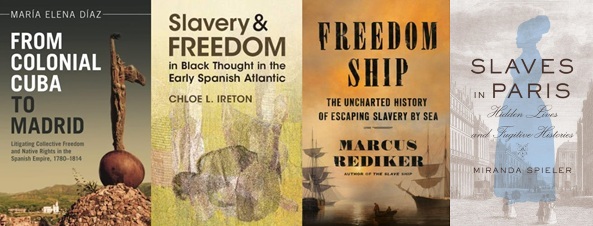
In their commitment to recognize the excellent books on the history of the Atlantic slave trade and slavery exploring any dimension, period, and geographical area, published in any country in English, French, Portuguese, or Spanish in 2025, jury members of the #Slaveryarchive Book Prize 2025 have announced the four finalists: From Colonial Cuba to Madrid, by María Elena Díaz (University of California Santa Cruz); Slavery and Freedom in Black Thought in the Early Spanish Atlantic, by Chloe L. Ireton (University College London); Freedom Ship: The Uncharted History of Escaping Slavery By Sea, by Marcus Rediker (University of Pittsburgh); and Slaves in Paris: Hidden Lives and Fugitive Histories, by Miranda Spieler (American University in Paris). The winner will be announced by mid-October 2026.
#Slaveryarchive Book Prize 2025 FINALISTS
Keeping our original commitment to recognize the excellent books on the history of the Atlantic slave trade and slavery exploring any dimension, period, and geographical area, published in any country in English, French, Portuguese, or Spanish in 2025, jury members Ana Lucia Araujo (Howard University, United States), Toby Green (King’s College London, United Kingdom), Miguel Valerio (University of Maryland, United States), Nicholas Radburn (University of Lancaster, United Kingdom) are pleased to announce the four finalists of the #Slaveryarchive Book Prize 2025. The winner will be announced by mid-October 2026.
From Colonial Cuba to Madrid by María Elena Díaz (University of California Santa Cruz) is a microhistory of a collective litigation for freedom from former royal slaves sold during Cuba’s sugar boom in the 1780s. Díaz examines the largest and most complex freedom suit litigated in the highest court of the Spanish empire at the end of the eighteenth century. The book offers a carefully researched study of one of the few Black communities that was able to secure freedom as well as political and legal recognition from the Spanish crown during the colonial period. Jury members praised the book for showing the place of law in shaping responses to violence. Jurors also commended the book for its excellent archival research and its steeped engagement with the historiography of slavery and colonial Cuba.
Slavery & Freedom in Black Thought in the Early Spanish Atlanticby Chloe L. Ireton (University College London, United Kingdom). Spanning from Seville in Spain to Mexico City in New Spain, this richly researched book follows enslaved men and women in the sixteenth-century Spanish Atlantic world. Drawing on their multiple oral and written exchanges, Ireton reveals how Africans and their enslaved and freed descendants engaged and challenged the law and theological discourses that legitimized slavery, while also addressing the meanings of freedom. Weaving hundreds of archival fragments, Ireton shows how enslaved people in the Spanish Atlantic world embraced the public sphere and paperwork cultures to develop political ideas of freedom. This beautifully written book was praised by the jury members for its powerful microhistories and narrative, and also for its genuine new lens to study the African diaspora in the sixteenth century.
Freedom Ship: The Uncharted History of Escaping Slavery by Sea by Marcus Rediker (University of Pittsburgh) offers the first overview of maritime escapes during the antebellum period in the United States. Jury members praised this history for its original argument. Rediker shows that maritime escapes were as important or more important than the underground railroad. Meanwhile, the tensions around them drove the Civil War and enslaved people saw these escapes as a redemption and resolution of the middle passage. Combining the broader history of resistance in the sea with individual histories, this pathfinding history from below is beautifully written, very deeply researched, and conveys a great humane empathy and understanding.
Slaves in Paris: Hidden Lives and Fugitive Histories by Miranda Spieler (American University of Paris) is an impressively well-researched collective biography. A rare book about slavery in metropolitan France, Slaves in Paris recovers the stories of several enslaved men, women, and children born in Africa and the Caribbean, who lived in bondage in eighteenth-century Paris. Spieler tells their family histories, their engagement with prominent Enlightenment figures, and shows how they resisted slavery. Jury members praised the book for being beautifully written and haunting, and for powerfully and comprehensively demolishing existing literature portraying Paris as a freedom haven for enslaved people in the eighteenth century.