Here we share excerpts from an excellent article from the UCLA Magazine (7 July 2026). John Harlow, with photos by Ryan Young, relates an ongoing research project by UCLA marine archaeologist Justin Dunnavant, a scholar on slave ships who has spent his career unearthing the stories of fugitive slave townships in the Caribbean. “Now,” Harlow writes, “his innovative mapping methods are expanding Black cultural history.”
Poisons and booby traps, underwater roads and tricky disguises — these are the survival tactics perfected by the Maroon, runaway slave communities that fanned out across the Caribbean in the 18th century. Their stories have been largely untold.
That’s about to change.
The word “maroon” is derived from the Spanish for “wild.” The Maroons were fugitives, a small fraction of the 12 million men, women and children estimated to have been kidnapped in Africa and sold into American slavery. Their very existence was systemically erased by colonialists, first to discourage others and later out of shame, says Justin Dunnavant, an assistant professor of anthropology at the UCLA Cotsen Institute of Archaeology and a scholar on slave ships.
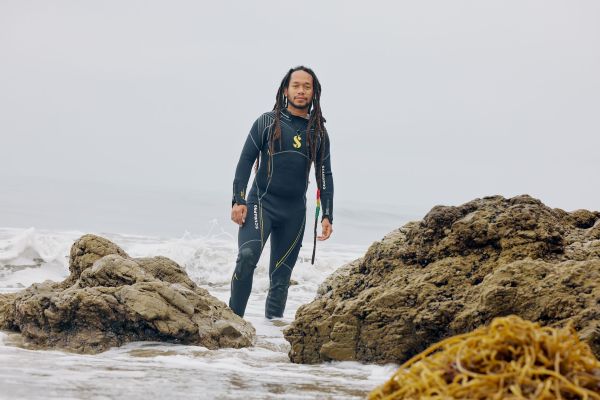
Dunnavant, who joined the UCLA faculty in July 2021, is a deep-sea diver and one of the very few African American archaeologists. He earned fame for his work recovering evidence and artifacts from a sunken slave ship in the Atlantic Ocean, a grim relic of the African-Brazilian slave trade. He has also excavated wrecks from the more familiar slave trade conducted between Western Europe and the American colonies.
Dunnavant became fascinated by the stories of the Maroon while studying the records of 140 slaves held at Estate Little Princess on the island of St. Croix, which was part of the former Danish West Indies and is now one of the U.S. Virgin Islands. Escapees who successfully got away formed a hidden village known as Maroon Ridge, then and now an isolated wilderness area of beach and mountain. They grew vegetables and bred small farm animals. And when faced with recapture, they fought off their former masters with equal brutality.
Dunnavant estimates that at its peak, Maroon Ridge was home to more than a hundred men, women and children. He recently returned from the Virgin Islands and says the area of the ridge, designated in 2025 as the Maroon Sanctuary Territorial Park, is an idyllic spot. But 250 years ago, life was hard and fierce, as the escaped slaves were forced to wage a constant guerrilla war against the plantation owners, who offered cash for the return of their “stolen property.”
But the new settlers were determined — and crafty. “The Maroon protected themselves with lethal booby traps, hidden in the vegetation and spiked with poisons derived from local plants,” Dunnavant says. “These toxins terrified the Danish colonialists. Maroon would raid the plantations in disguise as slaves and slip frog venoms into the food.”
Still, some were caught. Some were tortured or mutilated by limb amputation; others were burned alive.
These wars for survival, revealed through tireless foraging through colonial archives, is allowing the UCLA anthropologist to reconstruct the daily lives of the Maroon in the emerging field of study called “critical fabulation.” It’s a fresh method for illuminating the narratives of the enslaved, the overlooked and the lost through works of “creative nonfiction” based on hard facts and scattered evidence. “Our work,” Dunnavant says, “is about giving a voice to the silenced.” [. . .]
Thankfully, technology has come to historians’ rescue. The Virgin Islands have been mapped down to minute detail by satellites and ground-penetrating lidar probes; Dunnavant, along with colleagues from Vanderbilt University, has overlaid these images with archival records to identify areas around the coast and the ridge where archaeologists can now sift for clues aboutschol the Maroons and their legacy. Dunnavant characterizes the first pass, across six areas on the ridge, as “promising”; the new mapping techniques are now being deployed at other Maroon sites.
What happened to the Maroon Ridge communities? “Some found their way to Puerto Rico [around 120 miles away]. Some still identify as Maroon, in Jamaica and elsewhere, but they are being changed by modern life,” Dunnavant says. “After slavery ended, most vanished into the general Afro-Caribbean population across the region.” [. . .]
For full article, see https://newsroom.ucla.edu/magazine/justin-dunnavant-african-cultural-archaeology-maroon-caribbean-slavery