
Cree-Summer Haughton (ITV News, July 28, 2026) has been investigating claims that public access to Jamaica’s beaches is becoming increasingly difficult. Here are excerpts from her latest article. [Many thanks to Peter Jordens for bringing this item to our attention.]
“I need my beach.” It’s a simple sentence, but I heard it again and again while reporting across Jamaica.
For months, we had been investigating claims that public access to some of the island’s coastline was becoming increasingly difficult.
Long before Hurricane Melissa renewed attention on Jamaica’s shores in October 2025, campaigners were warning that beaches were disappearing behind hotel developments, private land and paywalls.
One place came up more than any other: Bob Marley Beach. Famous for being the reggae legend’s favourite stretch of coastline, this idyllic spot has been a place for locals to surf, fish and gather for generations. It’s also deeply connected to Jamaica’s Rastafarian community. But it has become the focus of a dispute after a hotel group started lobbying the government to build a luxury resort here.
While some see tourism development as essential to Jamaica’s economy, others believe ordinary people are slowly losing access to one of the country’s greatest natural resources.
[. . .] As we travelled around the island, campaigners argued these concerns weren’t isolated to one community.
Jamaica has around 494 miles of coastline, but campaign group JABBEM claims only a tiny proportion is easily accessible to locals.
Its chairman, Devon Taylor, believed the issue stretches far beyond individual beaches. “The people only have access to 2.8 miles of coastline,” he claimed. “It really paints the picture of landlessness.”
That is less than 1% of beach space that is free and accessible to locals.
Campaigners also point to Jamaica’s Beach Control Act, legislation introduced in 1956 before the island gained independence. They argue it gives too much control over the coastline to the government and developers, rather than the communities who have used these beaches for generations.
The debate has also drawn in one of Jamaica’s most recognisable families. Cedella Marley, daughter of reggae icon Bob Marley, told me that beaches form part of Jamaica’s identity. “Our people deserve better,” she said. “It was given to us by God and now it’s being taken away by man.”
The concerns aren’t limited to Kingston. In western Jamaica, residents are opposing proposals for new overwater bungalows linked to Sandals Resorts, fearing the development could further reduce public access to the coastline.
[. . .] Some Jamaicans told us the debate had become exaggerated and argued the island still has beaches people can use if they’re willing to travel. Others said private investment has helped maintain facilities that would otherwise fall into disrepair.
One beach operator, Laura Heron, told ITV News that maintaining public beaches comes at a cost. “We didn’t make this investment not to make money,” she said. “Maintaining the property to a high standard is costly.”
A series of hurricanes, including Hurricane Melissa, have intensified concerns about Jamaica’s coastline. [. . .]
Again and again, conversations returned to the same idea: identity.
One resident put it simply: “This is our birthright,” they said.
Whether Jamaica can continue growing its tourism industry while protecting public access to its beaches remains a deeply contested question. But after travelling across the island and speaking to people on both sides of the debate, one thing became clear: For many Jamaicans, this isn’t just a fight over sand. It’s a fight over who Jamaica’s coastline is really for. [. . .]
When approached for comment about its proposed overwater bungalows, Sandals Resorts referred ITV News to the Jamaica Hotel and Tourist Association (JHTA), which represents the interests of Jamaica’s tourism sector.
The JHTA said: “We believe that a world-class tourism product and meaningful public beach access are complementary national priorities that can and should be advanced together, in accordance with applicable regulations and policies.
“Achieving this requires a balanced approach that promotes environmental stewardship, public safety, the orderly management of these shared spaces, and respect for property rights. This should not be framed as tourism versus Jamaicans; rather, tourism, our communities, and our natural environment are all part of one interconnected ecosystem.” [. . .]
For full article, see https://www.itv.com/news/2026-07-29/i-need-my-beach-why-jamaicas-beaches-are-off-limits-to-locals
Also see our previous posts: https://repeatingislands.com/2025/10/08/jamaican-campaigners-launch-legal-action-to-defend-local-access-to-montego-bay-beach and https://repeatingislands.com/2026/06/19/jamaican-beach-access-campaigners-go-to-court-to-fight-privatization-of-coast
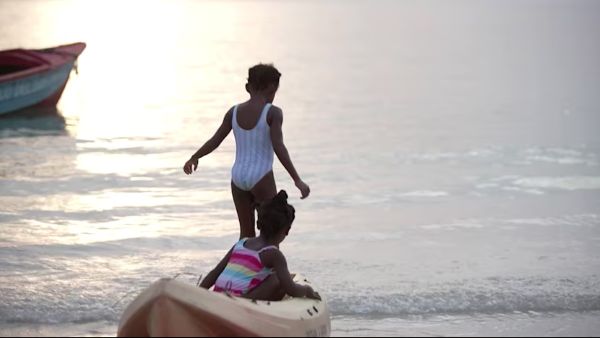
[Shown above: Kids enjoying the beach. Credit: ITV News.]