
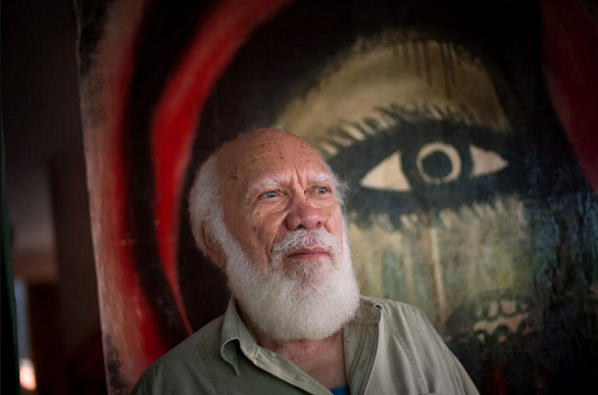
“A prolific novelist, poet, painter and soothsayer, he was inspired by the chaos of his country and published the first novel written entirely in Haitian Creole.” Randal C. Archibold (The New York Times, Feb. 26, 2025) presents a beautiful obituary article on Haitian artist and writer Frankétienne (1936-2025). Here are excerpts; read the full article in The New York Times.
The Haitian artist and writer known as Frankétienne, who published the first novel written entirely in Haitian Creole and who, as the nation’s foremost literary lion, refracted its chaos and disorder through art, died on Thursday at his home in Port-au-Prince, the nation’s capital. He was 88. The Haitian Culture Ministry announced the death. The cause was not specified.
“Through his writings, he illuminated the world, carried the soul of Haiti and defied silence,” Prime Minister Alix Didier Fils-Aimé said in a statement.
Frankétienne was a prolific novelist, poet and painter — often all three in a single work — whose art embraced and interpreted the chaos of the small, tumultuous country he came from.
“I am not afraid of chaos because chaos is the womb of light and life,” he said in a 2011 interview with The New York Times at his rambling gallery and home, in a working-class district of Port-au-Prince. “What I don’t like is nonmanagement of chaos. The reason Haiti looks more chaotic is because of nonmanagement.”

While not well known in the English-speaking world, Frankétienne was a larger-than-life figure in Haiti and was celebrated in French and Creole-speaking literary and diaspora circles around the world. He garnered an Order of Arts and Letters award in France, and his lively, unpredictable appearances drew crowds.
His output was varied and extensive, including some 50 written works in French and Haitian Creole and thousands of paintings and sketches, characterized by spirals of blacks, blues and reds, often with poems layered in.
Writing the novel “Dézafi” — published in 1975 and translated as “Cockfight” — in Haitian Creole was an important milestone for the language, derived from French colonizers and enslaved Africans, with a strong oral storytelling tradition. It is a looping, experimental work laced with poetry and elements of magical realism. The plot, involving Voodoo priests set upon by people they have put in a deathlike state, has come to be seen as an allegory of slavery and political oppression.
The novel was also a classic example of Spiralism, a Haitian literary movement, which he founded in the 1960s with the writers René Philoctète and Jean-Claude Fignolé, characterized by the idea of self-perpetuating chaos and creativity. [. . .]
Indeed, a conversation with Frankétienne could take on flights of fancy.
Kaiama L. Glover, an African American studies professor at Yale who has translated his works, recalled moderating a discussion with him in 2009 during which he leaped to his feet, ripped open his shirt to reveal prayer beads and began singing Voodoo prayers to make a point.
“He was just bellowing and calling on the spirits to express an answer on what it means to write in French and Creole,” Professor Glover said in an interview. [. . .]
The Haitian American writer Edwidge Danticat, who appeared with Frankétienne at conferences in Haiti and Miami and whose parents brought her to see his plays when they were performed in Brooklyn, said his death leaves a big gap.
“But as I’m sure he would say, the spiral continues in the generation that, in part, he helped nurture and which continues in his wake,” she said in an interview. “His novels and plays extended our vocabulary, expanding how we express love, passion, humor and rage,” she said. “His love for Haiti was so deep that sometimes he had to invent words to express it.” [. . .]
[Photos above by Allison Shelley for The New York Times.]
For full article, see https://www.nytimes.com/2025/02/26/world/americas/franketienne-dead.html