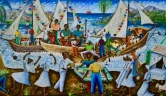

In the past 500 years, a dozen major earthquakes of magnitude 7.0 or greater have occurred in the Caribbean near Puerto Rico, the U.S. Virgin Islands and the island of Hispaniola, shared by Haiti and the Dominican Republic. Several of these have generated tsunamis. Before yesterday’s destructive earthquake in Port-au-Prince, the most recent major earthquake, a magnitude 8.1 which occurred in 1946 off the northeast coast of the Dominican Republic, triggered a tsunami that killed about 1,800 people. A major earthquake occurs on average every 50 years.
Here are some of the salient Caribbean earthquakes:
Although earlier milder quakes had been reported, the earliest devastating earthquake recorded in the region was the 1692 Jamaica earthquake, which struck Port Royal on June 7 at exactly 11.43 a.m., according to a stopped pocket watch found in the harbor. Much of the town, known both as the “storehouse and treasury of the West Indies” and “one of the wickedest places on earth,” sank below the sea. About 2,000 people died as a result of the earthquake and tsunami; about another 3,000 died of injuries and disease in the following days.
In 1781, a 10-foot high sea wave swept away houses and killed 10 people on the south coast of Jamaica after an earthquake that occurred during a hurricane.
In 1842, an earthquake generated a wave from 10 to 16 feet high along the northern coasts of the Dominican Republic, Haiti and the Virgin Islands. Several hundred fatalities were recorded at the time, but it’s not clear how many were tsunami-related.
In 1867, tragedy struck also on the afternoon of November 18, 1867, when a magnitude 7.5 earthquake occurred in the Anegada trough, located between the US Virgin Islands of St. Croix, and St. Thomas. The earthquake actually consisted of two shocks, separated by ten minutes. These shocks generated two tsunami waves that were recorded at several Island locations across the eastern Caribbean region, most notably on the Islands of St. Thomas and St. Croix. The first tsunami wave struck the town of Charlotte Amalie, on the island of St. Thomas. The second flooded Fredriksted in St. Croix, with waves of approximately 7.6 meters high. Only 17 lives were lost.
In 1918, another 7.5 magnitude earthquake in the Mona Passage, between Puerto Rico and Haiti, produced a 20-foot wave on the west coast of Puerto Rico. There were 116 fatalities, 40 of them directly from the tsunami.
Image: Contemporary illustration of the 1692 Jamaica earthquake
 Repeating Islands
Lisa,
What is the source of the 1692 tsunami illustration above?
Is it possible to get permission to use it in educational materials?
Please contact me via this email address.
Thank you.
LikeLike