Susan Mains, commissioner of the Grenada Pavilion at the 2026 Venice Biennale, introduces us to Trinidadian artist Edward Bowen and art critic Valentina Minniti, who examines Bowen’s work in the context of its references to Baudelaire’s “Correspondances” [Correspondences]. Note that the pavilion exhibition is entitled “The Poetics of Correspondence.” Mains writes, “This 9th time for Grenada has proven very advantageous, sealing our privilege of being the leader in the Caribbean as far as appearances. The inclusion of an artist from Trinidad, Edward Bowen, has broadened our scope. The pavilion was opened in May, and will continue until 22 November, a good long run for Grenada in the heart of Europe.”
Here are excerpts from Minniti’s review, “A landscape of correspondences by Edward Bowen: When colour remembers” (Now Grenada).
Among the artists featured in the Grenada Pavilion, curated by Daniele Radini Tedeschi for the 2026 Biennale di Venezia, Edward Bowen offers one of the exhibition’s most intimate reflections on the notion of Baudelairean correspondences. [. . .]
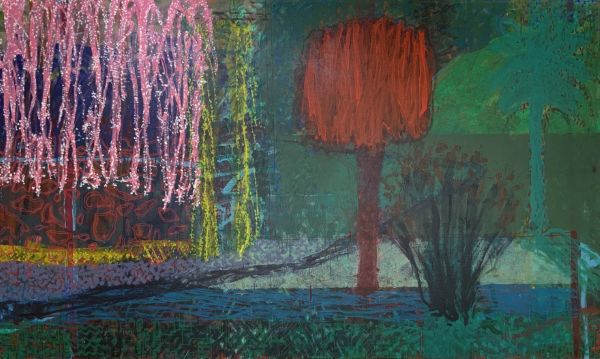
His painting, A Walk in the Park with Doctor Bob, resonates profoundly with the pavilion’s invitation to look beyond appearances in order to discover the visible and invisible relationships that bind individuals to one another, but above all to memory, nature, and the realm of emotions. By establishing a poignant dialogue between lived experience and artistic creation, the work reveals its remarkable subtlety as a landscape of memory, in which the symbolism of colour unveils the spiritual correspondences that animate nature.
Despite appearing to belong to the tradition of landscape painting, the scene the painting recreates functions less as a subject than as a pretext. Inspired by “my experience in the last 4 years with my good friend walking in the botanical gardens in Port of Spain, Trinidad,” as Bowen explained, the artist did not depict a garden so much as the experience of walking through one: instead of recounting a sequence of events, the artist opted for a stream of consciousness rendered through expressive brushwork as well as an interplay between recognisable forms and their gradual transfiguration into living presences. Indeed, the logic of Proustian memory is already contained in the title itself: “the walk” is at once singular and cumulative, condensing countless walks into a single reimagined image. Memory reshapes events, allowing different moments to converge towards an intermediate space where biography and imagination become inseparable: lived experience becomes pictorial memory.
The transformation of lived encounters into a multilayered painted scenario also concerns the visual language through which Bowen constructs the landscape. If the underlying drawing establishes the architecture of a space, painting loosens that structure, allowing gesture and colour to emerge as the primary media through which memory acquires a commanding visual presence: saturated reds, incandescent pinks, luminous blues, and deep greens resist descriptive naturalism. A crimson tree anchors the composition like a totemic presence, while cascades of vivid pink foliage hover between vegetation and apparition. A dense band of blue suggests water, yet its painterly treatment dissolves any straightforward illusion of depth: while the landscape remains recognisable — trees, meadow, water, sky — its physical coherence yields to an emotional logic. Colour no longer describes the world; it remembers it and translates remembrance into chromatic perception. [. . .]
For full review, see https://nowgrenada.com/2026/08/a-landscape-of-correspondences-by-edward-bowen/
[Shown above: Edward Bowen’s “Walk in the Park with Doctor Bob.”