Here are excerpts from an incisive— and, at times, poignant— review of the 2026 Venice Biennale’s “In Minor Keys” by Hakim Bishara (Hyperallergic). He writes, “The main exhibition of the 2026 Venice Biennale sets rage and retribution aside, relaxing the oppressed’s clenched fist for a moment of calm, centeredness, and self-forgiveness.” At the risk of revealing too much about my own tastes, I must share this particularly enjoyable gem of a paragraph: “It’s a solid hymn to the billions who carry melancholy and riotous joy in the same heart. Those with a generational short fuse but endless endurance. Those who swim in grief but throw the best parties.”
Here we share segments that consider work by Caribbean artists included in “In Minor Keys” such as María Magdalena Campos-Pons (Cuba-US), Annalee Davis (Barbados), and Daniel Lind Ramos’s (Puerto Rico).
If you’re Eurocentric by disposition, confident that the West is the single source of high art and ideas of progress, then don’t visit Koyo Kouoh’s exhibition In Minor Keys at the 2026 Venice Biennale.
If you bristle at the mention of White colonizers, this show is not for you, though it might be partly about you.
Moreover, if you’re convinced that what’s happened in Gaza over the last three years looks nothing like a genocide, you’re in for boatloads of protest signs and solidarity statements that tell you just how dead wrong you are.
This posthumous exhibition, the crown jewel of a momentous biennale, is a triumph of the historically dispossessed and overlooked, the proud and beautiful “wretched of the earth.”
It’s a solid hymn to the billions who carry melancholy and riotous joy in the same heart. Those with a generational short fuse but endless endurance. Those who swim in grief, but throw the best parties.
Call them the Global South, or Global Majority. Call them Black and Brown people. Call them the “developing world.” Call them whatever you want. [. . .]
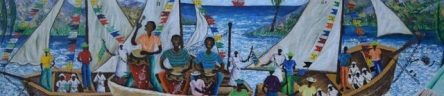
María Magdalena Campos-Pons (Cuba-US) provides a bigger spectacle in her tribute to Kouoh, in a colossal painting that depicts her standing alongside Black American novelist Toni Morrison, surrounded by sculpted flowers on the floor. That, too, can be called a shrine. (Campos-Pons also led a moving procession in the Giardini in memory of the late curator). Also unforgettable are Daniel Lind Ramos’s (Puerto Rico) anthropomorphic bricolage sculptures, assembled with found objects — fabrics, pieces of tarp, trash can lids, drums — and emoted by history. [. . .]

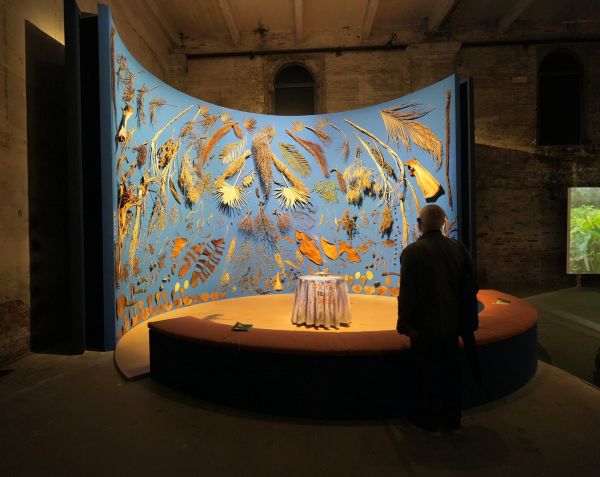
Another cartographic tapestry by Alice Maher and Rachel Fallon reimagines the map of their homeland, Ireland, by highlighting sites of harm to women, such as Magdalene Laundries, punitive colonies for unmarried, ”promiscuous,” and sexually abused women. Walid Raad (Lebanon-US) creates a memorial to the surprising paths of history through palettes used for weapons shipments after Lebanon’s Civil War, which had been painted with copies of famous Arab and Turkish paintings. Annalee Davis (Barbados) presents a living herbarium sourced from the former plantation where her family has lived for generations. [. . .]
I could go on and on, but after all the above, don’t let anyone tell you this exhibition isn’t political enough. [. . .]
On a much deeper level, In Minor Keys successfully plugs into the unseen recesses of political resistance — that subterranean quietude and focus that allow for centuries of endurance. That’s the sound of the strength and confidence of people who see themselves as part of the soil and fauna of their native lands. It’s an ancestral frequency that no foreign colonizer can tune into, not even after ages of settling a land that isn’t theirs.
One of the artists in the exhibition that stuck with me most is Gaza-born painter Mohammed Joha, who’s been living in Marseille, France, in recent years. He overlays fabric and cardboard onto canvas to create outstanding abstract collages that recall the tents and tin shacks that people from Gaza have to live under after being robbed of their homes. The series is heartbreakingly titled No Shelter. [. . .]
For full article, see https://hyperallergic.com/centuries-of-endurance-undergird-in-minor-keys/
[Shown above, photos by Hrag Vartanian/Hyperallergic: 1) Annalee Davis, Let this be my Cathedral (2026) (); and 2) Daniel Lind Ramos, “Talegas de la Memoria II” (2025).]