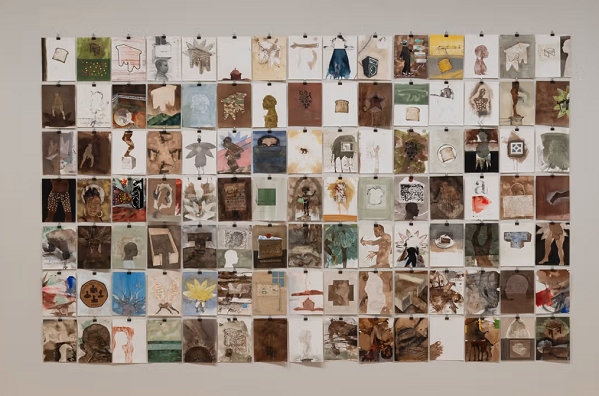
As part of the exhibition the “Collection 1880s–1940s,” Jacob Lawrence and Christopher Cozier is on view in Room 520 (of the Alfred H. Barr, Jr. Galleries, 5th Floor) through fall 2025. MoMA Magazine shares Cozier’s thoughts: “The artist explains his epic series of drawings.” Here are excerpts of his account, preceded by an introduction by curator Esther Adler.
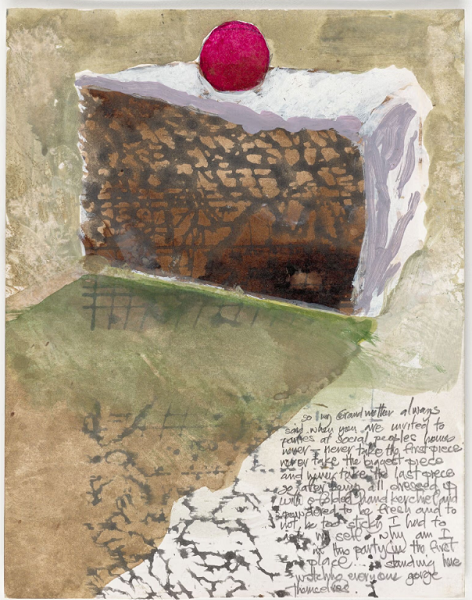
Esther Adler (Curator, Department of Drawings and Prints) writes: “I learn something new every time I speak with the artist Christopher Cozier. Sometimes it’s about a detail that appears in his monumental drawings series Tropical Night—for example, the cluster of grapes that appears on a number of sheets is taken from the cover of Nelson’s West Indian Readers, an early literacy textbook first published in 1928 that people who grew up in the Caribbean may recognize. More often, it’s about the history of Trinidad and Tobago, and how living and working in the Caribbean shapes every aspect of his work in one way or another. Cozier spoke with us about all of this when installing Tropical Night in 2024 in dialogue with Jacob Lawrence’s more linear narrative Migration Series. Having reinstalled the work this year, in a new configuration with a new selection from the 268 sheets that make up the work, his insights are as relevant as ever.
My name is Christopher Cozier. I’m an artist and I live in Port of Spain, in Trinidad, in the Caribbean…
I actually met Jacob Lawrence. He came to Trinidad when I was young, and I met him very briefly. And now we meet again! When I first heard about [this gallery], I was a little confused because he is a mid-20th-century protagonist, and I’m an early-21st-century protagonist, and yes, we’re both Black, but I’m from the Caribbean. And the Caribbean isn’t necessarily a sub-narrative of the American and the Afro-American narrative. It’s entwined, it’s not the same narrative. But then by subscribing to those anxieties, I would therefore be subscribing to a very traditional canonical construction of history, which I gather that MoMA is trying to contend with in their rehanging.
[Just before making my Tropical Night series,] I was going through a kind of personal crisis, trying to figure out where my work was going, what the vocabularies were. I had started two other similar series, but they never got off the ground because I had to break them up just to survive. They were sold.
I got a Krasner-Pollock [Foundation] grant in 2004, and what I decided is I will start a new set of drawings, which I will be able to hold onto because I had funds to let it grow. I was traveling a lot, and so my studio became a kind of itinerant studio, where it could be a hotel room, a friend’s place. So this scale seemed to work perfectly for me. I was responding to things that I was seeing and feeling.
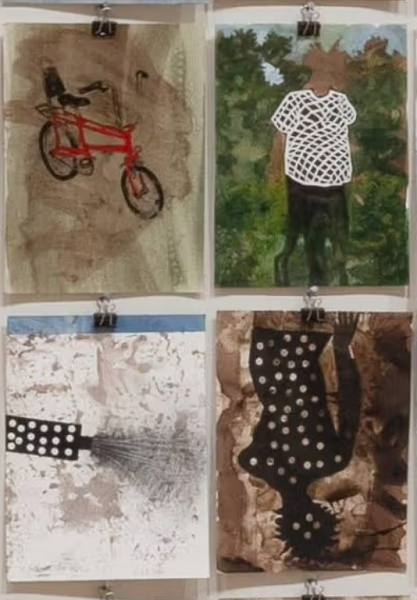
The series got to about 50 or 60 drawings around 2006. It was a combination of formal experiments and also very specific signs. If you look at [the drawings], you can step back and have this larger encounter, where it conveys a tone, almost in a phenomenological sense. Or you could zoom in and go into the details. It has texts, it has images. I did not see it as a fixed thing. The reason why the drawings are suspended on paperclips, bulldog clips, is that I felt it would be fluid. Each time it’s shown, the arrangement would be different based on what’s going on in the world or how I’m feeling.
Things come up as the world changed. The basic idea that I’m responding to when I started this body of work was in the ’70s, the era when I was coming of age, Trinidad had a revolutionary period. I was too young to really understand what was going on, but what stayed with me was the tone of that environment because young people were killed. They were like sacrificial lambs for this new consumer reality of shopping malls. And then I was studying in the U.S. and learning more about the whole Latin American project. When I returned home, there was an insurrection where an Islamic cult had invaded the parliament and held the parliament hostage for nine days. And during that period, there was a lot of violence, a lot of looting, and a lot of destruction of the city that I had grown up in. [. . .]
I am an artist from Port of Spain, but this work was done in many different locations over a period of years. I think that kind of itinerancy is very much part of the Caribbean experience. The Caribbean is a way of seeing the world based on a very particular kind of historical experience. The plantation culture, the birth of the global economic system, the Anthropocene, everything seems to have its source in the Caribbean. In this body of work, I’m navigating some of those territories, navigating the symbolism, the vocabularies. I am hoping that people could enter it in a similar way.
My intentions were a counternarrative to the notion of the “tropical,” which is supposed to be colorful and fruity. But actually, in the Southern Caribbean, where the climate is more equatorial—we are just seven miles off the coast of Venezuela—it’s much more Amazonian. Most of the year it rains. So whose construction of the Caribbean are we subscribing to? And then of course after night is always day, right? So, in a cheeky way, I call it Tropical Night because the night is a kind of fertile ground for anticipating the return. [. . .]
For full article, see https://www.moma.org/magazine/articles/1340
Also see our previous post: https://repeatingislands.com/2025/07/25/exhibition-jacob-lawrence-and-christopher-cozier/
[Shown above: 1) Gallery view of Tropical Night. 2) Detail from Christopher Cozier’s March 2024 installation of Tropical Night. 2006–14. 268 sheets with acrylic, ink, colored ink, pencil, and colored pencil on paper, some with stamped ink, stencil, solvent transfer, and cut-and-pasted colored and painted paper, each 9 × 7″ (22.9 × 17.8 cm). The Museum of Modern Art, New York. Latin American and Caribbean Fund and Fund for the Twenty-First Century. © Christopher Cozier.]