

Through Fall 2025, the Museum of Modern Art (MoMA) highlights “Jacob Lawrence and Christopher Cozier,” organized by curator Esther Adler, with curatorial assistant Rachel Remick, as part of the exhibition the “Collection 1880s–1940s” exhibition. Located on Floor 5, Room 520 of the Alfred H. Barr, Jr. Galleries, this selection places Cozier’s Tropical Night (reinstalled in 2025) in dialogue with Jacob Lawrence’s Migration Series.
- Christopher Cozier: Born 1959, Trinidad and Tobago
- Jacob Lawrence: United States, 1917–2000
Description: For several decades beginning during World War I, millions of Black Americans left the Southern United States for the North, Midwest, and West—a mass exodus known as the Great Migration. A child of migrants, painter Jacob Lawrence grew up in Harlem, where he set out from an early age to make art that addressed Black histories. “This is my genre . . . the happiness, tragedies, and the sorrows of mankind,” Lawrence stated. In 1940 he embarked on making the Migration Series.
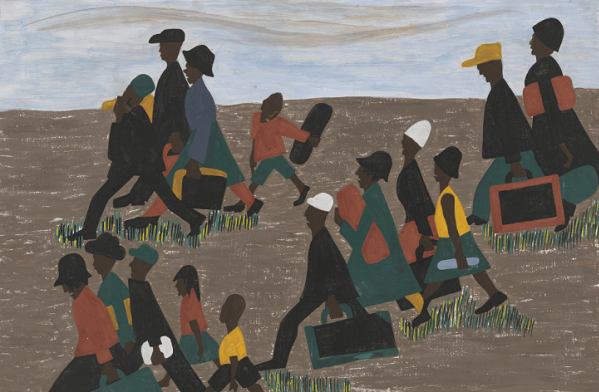
Artist Christopher Cozier’s own migration story began in 1983, when he left Trinidad and Tobago to study in the United States, where he was embraced by New York’s creative community. In 1988 he returned to his home country to live and work, but continued to travel, navigating both the international art world and stereotypes and myths of and from the Caribbean. Cozier’s experiences of different places inform Tropical Night (2006–14), which, like Lawrence’s work, unfolds across multiple compositions. It does not offer a set narrative but encourages us to create our own.
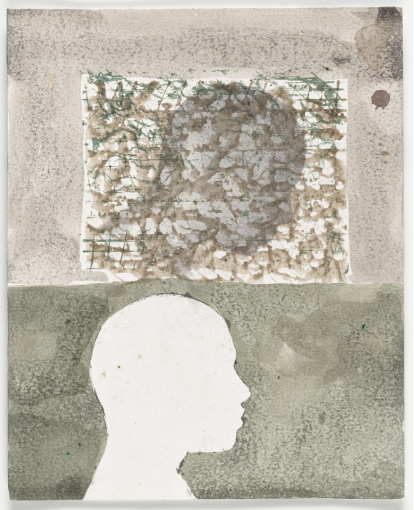
Tropical Night is a complex, diaristic account of Cozier’s experiences in his home country and as an itinerant artist traveling throughout the Caribbean, the U.S., and the world. Forms are repeated across its individual sheets: a historical map of part of the Eastern Hemisphere—the ancestral home of many of Trinidad and Tobago’s inhabitants today; a silhouette of the parliament building in the capital, Port of Spain; dancers from Carnival celebrations; and a household bench found throughout the region. The individual drawings are reshuffled into a new order each time the work is installed. “There are narrative passages. There are moments when I see a path, and I try to run it down,” Cozier says. And yet, “Sometimes I don’t want to prescribe the reading.”
For more information, visit https://www.moma.org/calendar/galleries/5701
2 thoughts on “Exhibition: “Jacob Lawrence and Christopher Cozier””