
[Many thanks to Professor Ángel Acosta Colón and Karst & Caves Puerto Rico for bringing this item to our attention.] So interesting! In 2017, ZLS and Zootaxa announced the discovery of a previously undescribed species of giant tortoise (Chelonoidis marcanoi) in the Dominican Republic. Now, after extensive paleontological explorations in the Las Cabachuelas Nature Reserve in Morovis, Puerto Rico, scientists announced the presence of fossil remains of land tortoises of the genus Chelonoidis.
Jorge Vélez-Juarbe (paleontologist and associate curator of Marine Mammals at the Natural History Museum of Los Angeles County) shared a brief description of his team’s recent paper, published on November 19, 2026, in the Journal of Vertebrate Paleontology. Here are excerpts from his post.
Today, we welcome a new member to the list of Puerto Rico’s extinct fauna!
In our new study, we document—for the first time—the presence of land tortoises of the genus Chelonoidis in Puerto Rico, based on both adult and juvenile specimens.
During the Quaternary period, the Antilles were home to an endemic radiation of land tortoises, much like what we see today in the Galápagos Islands. However, these Antillean tortoises went extinct at different times; on some islands, this appears to have happened before the arrival of humans, while on others, their disappearance occurred later and may have been linked to human activity.
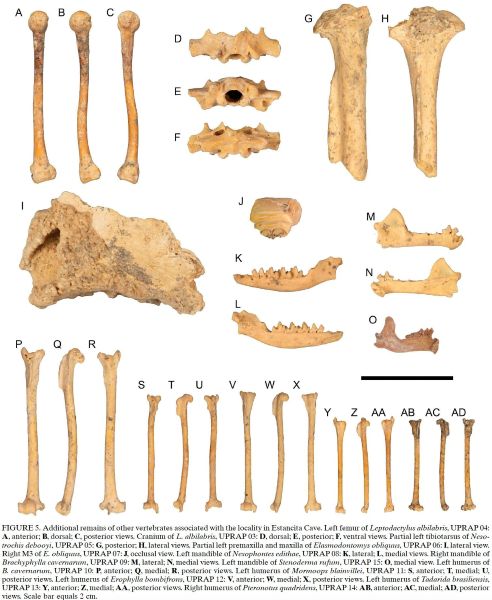
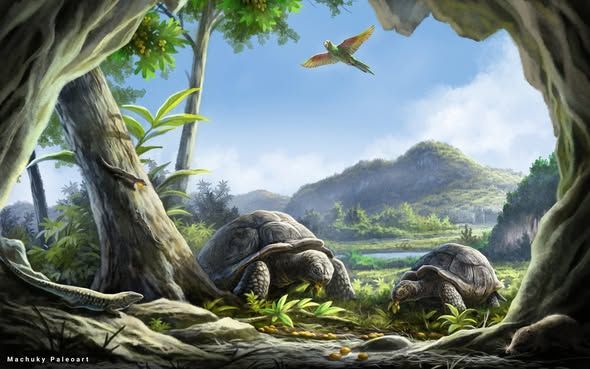
One of the Puerto Rican specimens—a left humerus—was discovered alongside a faunal assemblage suggesting it is at least 16,300 years old. This associated fauna includes extinct species, such as the Puerto Rican shrew (Nesophontes edithae) and the Puerto Rican parakeet (Psittacara maugei), as well as species that are still part of our fauna today, including the common ground lizard (Pholidoscelis exsul) and the crested anole (Anolis cristatellus). One of the topics we explore in our paper is the extinction of frugivorous (fruit-eating) vertebrates in Puerto Rico and the potential consequences this had for native and endemic plants that produce large fruits and seeds. The disappearance of sloths (Acratocnus odontrigonus), giant rodents (Elasmodontomys obliquus), iguanas (Cyclura pinguis), and tortoises (Chelonoidis sp.) likely had a negative impact on the seed dispersal of these plants, several of which currently lack natural dispersers. [. . .]
A biostratigraphic comparison of Nesophontes edithae jaws found alongside the bone of an adult tortoise links them to a smaller morphotype, dating to between approximately 50,000 and 16,300 years ago. This establishes a minimum age of about 16,300 years for the Morovis tortoise site, demonstrating that land tortoises inhabited Puerto Rico long before the arrival of the first humans (approximately 6,250–6,000 years ago) and supporting the existence of a complex, asynchronous pattern of tortoise extinction throughout the Antilles. [. . .]
For more information, see Vélez-Juarbe, J., Vega-Pagán, K. A., Soto-Centeno, J. A., Viñola-López, L. W., Vázquez Méndez, S. I., Meléndez-Meléndez, F., & Acosta-Colón, Á. A. (2026). “Late Quaternary Chelonoidis (Testudines, Testudinidae) from the Puerto Rico Bank: extinction and ecological role of West Indian tortoises.” Journal of Vertebrate Paleontology. https://doi.org/10.1080/02724634.2026.2751429
See original post at https://www.facebook.com/jorge.velezjuarbe
[Drawings of fossils (and the illustration above, by Machuky Art) were taken from a post by Jorge Vélez-Juarbe.]