
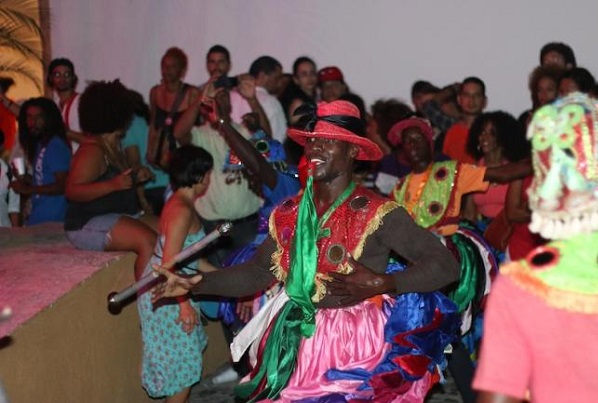
Simón Rodríguez (NACLA) writes about the persistence of Afro-Dominican culture, despite “the ongoing criminalization and racist persecution of African tradition, from the criminalization of Vodou to restrictions against Gagá.” Read the complete article and see more photos at NACLA.
“Are these children taught about God? Are they taught the Bible, do they believe God?” On May 21, 2024, Iván Ruiz, host of the Midday Show, one of the most-watched TV programs in the Dominican Republic, asked these questions to the children’s dance group of the Fundación Cultural Herencia Viva de Mata de los Indios, who had intended to perform Afro-Dominican dances on the show. “I was in shock,” recalled Lisaury del Rosario, the group’s director and choreographer. Ruiz, who heads the State Corporation of Radio and Television, had warned off-camera that “he did not go with that culture… He said: ‘get them in quickly and get them out,’” del Rosario recalled in a public denunciation of the experience. Presumably as a result of Ruiz’s orders, the group did not perform any dance and barely lasted 80 seconds in front of the cameras.
The group had expected to dance on TV as part of an effort to raise funds to attend the Fiesta del Fuego Festival in Santiago de Cuba, to which they had been invited. The producers had asked them if they planned to perform Gagá, a dance linked to a religious celebration of African origin present in both Haiti and the Dominican Republic. Del Rosario had clarified that they wouldn’t. Ruiz asked on the air if they knew how to dance merengue—a popular genre elevated to national primacy during the dictatorship of Rafael Leónidas Trujillo. In a thinly veiled way, the questions about God and merengue are ways of verifying whether the girls, who are Black, are really Dominican.
Mata de los Indios is a community with a strong cultural tradition in North Santo Domingo and the birthplace of legendary figures of Afro-Dominican music, such as Enerolisa Núñez, singer of the salve tradition, and the late folklorist and musician Sixto Minier, known as Father of the Congos for his leading role in the Congos de Villa Mella. The organization is also recognized by UNESCO on its list of Intangible Cultural Heritage of Humanity. Herencia Viva, directed by del Rosario, operates without a physical location or state funding. Still, she is convinced that her work helps to prevent criminal violence in the community and “to fight so that culture is not lost.”
The producers’ questions about Gagá may have been motivated by legal concerns. Regulation 824, governing the National Commission of Public Entertainment and Radio (CNEPR), an agency regulating media broadcasting, censures African dances in the Dominican Republic. Drafted in 1971 by the dictatorship of Joaquín Balaguer, one of its articles bans “rumbas, African dances, striptease and all dances which are considered offensive to morality and public decency” from television or live performances in which minors are part of the audience. The regulation instructs the CNEPR to prevent public broadcasts or live performances that “may be detrimental to the principles and norms of the Dominican people.” As such, Afro-Dominican dances are legally restricted because they are deemed anti-national and immoral.
There have been attempts to modernize the CNPER. In 2005, President Leonel Fernández issued a decree to replace Regulation 824. But its censorious content persisted, prohibiting anarchist content and offenses to the official cult of national heroes. In the face of strong opposition, it was repealed within two weeks, and Regulation 824 was reinstated. Another reform was announced in 2021, but nothing was done. A draft “Law of Freedom of Expression,” presented by President Luis Abinader in April 2024, would repeal Regulation 824 and dissolve the CNEPR, replacing it with a new regulatory body with additional tasks, such as monitoring online activity. However, this new law, the text of which remains unknown to the public, has not been approved by Congress. Regulation 824 prohibiting African dances in television is still in force.
Censorship at the Service of Political Control
[. . .] Vodou religion is also criminalized by Trujillo’s Law 391. The non-profit organization Identidad Dominicana recently filed an appeal of unconstitutionality against the law. The appeal has been pending since April 2024, but ultra-conservative sectors linked to the government vocally endorse Law 391. In September, Evangelical leader Ezequiel Molina stated in a tweet that Vodou should remain illegal because it is a “satanic cult.” “We are a Christian country. [To legalize it] would be the worst curse,” he declared.
Neotrujillismo and Cultural Repression
The conflict between the ideological and institutional apparatus of the Dominican regime and cultural expressions of African origin is part of a broader system of racist repression. This has been described as an apartheid regime by various authors after the denationalization of hundreds of thousands of Dominicans of Haitian descent in 2013. Even intellectuals affiliated with the current government, such as the ambassador of the Dominican Republic in Mexico, Juan Bolívar Díaz, have denounced Dominican apartheid in the past.
Extensive academic literature recognizes Gagá, Vodou, and other cultural expressions of African origin as part of the Dominican cultural heritage, dating back to the first Spanish colony that brought an enslaved population of African origin in the 15th century. Sociologist Carlos Andújar observed that in the 1990s, more than 40 percent of homes in popular neighborhoods and rural sectors of the Dominican Republic had some altar or symbolic element related to Vodou. June Rosenberg, Dagoberto Tejeda, and Geo Ripley, among many other scholars, have written about the Dominican variant of this religion. Lusitania Martinez locates the beginning of the repression against Vodou and the music and dance of African origin to 1862 in the context of the short-lived re-annexation of the Dominican Republic by Spain. In 1992, the cult of the Cemetery Baron, the most popular manifestation of Dominican Vodou at the time, was banned. [. . .]
For full article, see https://nacla.org/forbidden-african-legacies-dominican-republic
[Shown above, photo by Guillermo Casado: Gagá de Mata Mamón takes part in a concert organized by Convite Pro-Diversidad in Santo Domingo’s Colonial Zone, protesting and defying 2014 restrictions on Gagá celebrations.]