
Jacqueline Charles (Miami Herald) writes about Edouard Duval-Carrié’s participation in the 2026 Venice Biennale. Visit the Miami Herald for this excellent article, photographs, and the videos “Bridging Cultures at the Venice Biennale” and “The Ghost of Toussaint.”
He calls it the “magic calabash.” For years, visitors to Edouard Duval-Carrié’s Little Haiti studio would find among his glittery and translucent historical figures and Vodou gods a story the artist could not shrug. Tacked to a wall was a tattered Miami Herald newspaper clipping that told a familiar story: A group of Haitian migrants washing ashore in South Florida after a perilous journey at sea.
Buried in the details about the overcrowded boat was the tale of a $3,500 calabash that someone carried to ward off capture by the U.S. Coast Guard.
“Can you imagine?” he said recently, recalling the story. “The most expensive item was not just a calabash but a magic calabash. Somebody’s holding this thing, and they throw it at the Coast Guard so it can disappear?”
The extravagance of the hard shelled spherical fruit, which is often used as bowls in rural Haiti, first registered as “outrageous” to Duval-Carrié, who tried to reconcile the fact that the voyage cost $20,000 to launch, and the boat was packed with four times the number of people it was built to hold. But then, as it usually does for the Haiti-born artist and sculptor who often explores Haitian identity and spirituality in his work, something sparked.
“I am going to make a painting of it,” he recalled deciding.
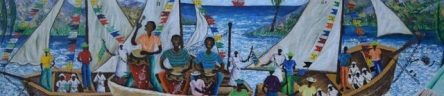
The painting of a group of well-dressed, wry Vodou deities, known as lwas in Haitian Creole, arriving on a crowded boat, one carrying a calabash, would make up part of his first big exhibition, “Who’s Coming to Dinner to Miami,” at Pérez Art Museum Miami. Now the installation — and the calabash that triggered it — is serving inspiration once more.
It’s become the foundation for one of the biggest moments of Duval-Carrié’s already internationally acclaimed career: his exhibition at the 61st Venice Biennale, the art world’s premier international exhibition. Staged every two years since 1895, it includes dozens of national pavilions and large-scale group shows organized by a curator.
It is an important moment for Miami and for the contemporary artist who in November 2024 became the second artist-in-residence in Miami-Dade County. He is one of two Haiti-born artists invited to exhibit at the Biennale’s premier event, which runs Saturday through Nov. 22 in Italy. “Haiti is all I am going to speak about,” Duval-Carrié gushed during a recent visit to his studio where he spoke about his Venice installation and the inspiration whose themes of migration, spirituality and identity still resonate today.
‘In Minor Keys’
This marks Duval-Carrié’s second appearance at the Biennale. His first appearance was 10 year ago when Haiti mounted a pavilion with support from the French government. This time, the artist doesn’t have a country behind him and had to independently raise funds through a network that includes longtime supporter Oolite Arts.
He will be exhibiting alongside another Haiti-born contemporary artist, Manuel Mathieu of Montreal and Paris, in the main exhibition. [. . .]
For those who follow Haitian art and culture closely, the inclusion of Duval-Carrié Vodou Pantheon in the Biennale carries even more of a special meaning because he’s bringing the ancestral spirits of Haiti to take their place in Venice, a city that understands the power of water, memory and transformation, said Kimberly Green, founder of Green Space Miami art gallery and longtime supporter of the country and its arts community. “His detailed and intricate, brightly colored work reminds the world that Haiti’s spiritual brilliance travels, endures and reshapes every shore it touches,” she added. [. . .]
In the Perez Museum exhibit “Who’s Coming to Dinner in Miami” that his Biennale show builds upon, the Vodou deities are headed to Miami, the gateway where the Haitian community, Duval-Carrié said, is “a force.” “I imagined them as the people of Haiti, those gods, because that’s what they are,” he said. “They represent the people and all I had to do was to put them together.”
“It’s daring, and it’s human and there’s a tragedy involved,” Duval-Carrié added, switching into Haitian-Creole to explain the painful decision Haitians have to make before embarking on such a perilous sea crossing and challenges they encounter on the other side of that decision. [. . .]
For full article, see https://www.miamiherald.com/news/nation-world/world/americas/haiti/article315426588.html
[Photo above by Carl Juste cjuste@miamiherald.com. Edouard Duval-Carrié, known for his vibrant, mixed-media works exploring Caribbean history and culture, will show his work at the prestigious Venice Biennale.]