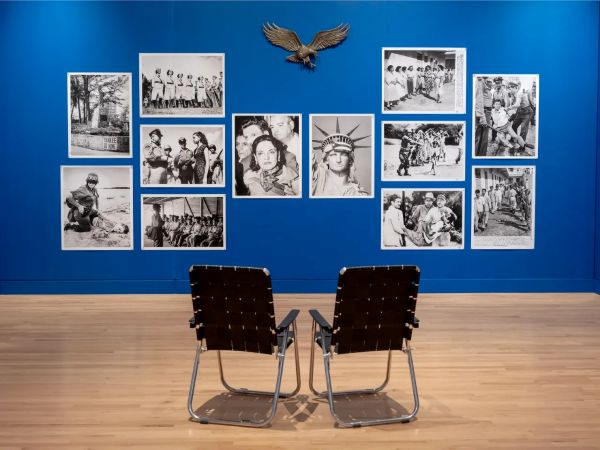
In “The 100 Best Artworks About America” (ARTnews) Harrison Jacobs, Tessa Solomon— editors of ARTnews and Art in America— et al, have compiled brief descriptions of artists who have produced the best works about the United States. Along with artists such as Frederic Church, Winslow Homer, Frida Kahlo, and Diego Rivera, we find Caribbean-rooted artists Pablo Delano (whose work is shown above), the late Félix González-Torres, and Martin Wong. Here are excerpts.
What exactly defines America? It’s a question that’s been asked for more than two centuries, and it’s one not likely to be conclusively answered anytime soon. But, with the 250th anniversary of the nation’s founding fast approaching, we took the occasion to hash out a response to that query, using art as a guide. [. . .]
Together, the editors of ARTnews and Art in America have constructed a list of the 100 best artworks about America. This is not a list of the best artworks by Americans, to be clear. (More here on why we didn’t go that route.) Instead, it’s a list of the best artworks responding to American identity and all the issues that attend it. [. . .]
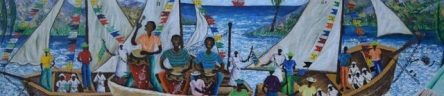
88. Martin Wong, El Caribe, 1988— In the paintings of its steadfast documentarian, Martin Wong, Manhattan’s Lower East Side—or Loisaida, to its historic Puerto Rican community—feels less like the melting pot it was at the time than a pressure cooker. It was here that Wong—an openly gay Chinese American from Portland—found himself drawn to the local Puerto Rican bikers. El Caribe is not exactly a self-portrait, but a depiction of Wong’s alter ego: an idealized and beautiful Puerto Rican man, according to the auction house Phillips. Wong was one of the many immigrants living on the LES so marginalized they often went uncounted in the state census. But rather than despair, he embraced the social porosity that allows individuals typically divided by language and geography to forge together a sense of belonging. Class and skin color may be America’s unspoken conditions of citizenship, but Wong reveled in his rebuke; anyone but the gang could eat his dust. —T.S.

75. Pablo Delano, The Museum of the Old Colony, 2016–ongoing [shown above]— For over two decades, Pablo Delano has been building up an archive of the material life of Puerto Rico. There are books, photographs, and maps; old school cameras and typewriters; tourist souvenirs, toys, and commercial products like soap and a soda called Old Colony; furniture and sculptures—the list goes on. Over the years, he has organized these in massive, room-size installations that mimic museological displays about Puerto Rico, the oldest colony in the world and a territory of the United States since 1898. Delano’s installation serves as a tongue-in-cheek critique of American imperialism, which has often hidden behind the national image of 13 colonies who fought for their own freedom as a way to deflect the colonial rule the US has imposed on various islands around the world. Eschewing the labels or explanatory texts of that an anthropological museum might use for a display of this kind, Delano keys into what visitors, especially American ones, already know about Puerto Rico and its colonial status in the US. This might go over the heads of some who may view it as just another immersive display of a tropical place, but for others, the piece will act as a pointed assessment of the US that feels all the more salient in 2026. —M.D.
55. Felix Gonzalez-Torres, “Untitled” (America), 1994— Last year, the Whitney Museum opened an exhibition of works from its permanent collection from over the years. The show, which is still on view as of this writing, is named “‘Untitled’ (America)” after this piece by Felix Gonzalez-Torres, which hangs in one of the museum’s windows for the occasion. The ingredients of the painting eve are highly specific—it is made up of 12 individual parts/light strings, each comprising 42 light bulbs. But the artist indicated that it may be displayed in any way a curator or institution deems fit. In that way, it functions as a sort of metaphor for democracy. Gonzalez-Torres himself once said of America and its democracy, “America has always been an unattainable dream, a place to dream about. . . . The America that I now know is still a place of light, a place of opportunities, of risks, of justice, of racism, of injustice, of hunger and excess, of pleasure and growth. Democracy is a constant job, a collective dedication.” In October 2024, the Smithsonian National Portrait Gallery displayed the piece in several locations, including on the museum’s facade, as part of an exhibition of Gonzalez-Torres’s work. In June 2025, a month before the show closed, President Trump announced he had fired the museum’s director, Kim Sajet, calling her “highly partisan” and a supporter of DEI. She refused to leave, and ultimately resigned. America is still the place Gonzalez Torres knew: terrible and hopeful, all at once. —S.D. [. . .]
For full article, see https://www.artnews.com/list/art-news/news/100-best-artworks-about-america-1234786764/
[Photos shown above: 1) Pablo Delano, The Museum of the Old Colony, 2016–ongoing. Artwork copyright © Pablo Delano. Courtesy New Britain Museum of American Art. 2) Martin Wong, El Caribe, 1988. Artwork copyright © The Martin Wong Foundation, courtesy P·P·O·W, New York.]