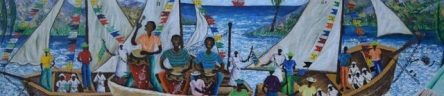

This year, the Tribeca Film Festival in New York city, running from June 3 to 14, 2026, includes Cuban, Dominican, Haitian, and Puerto Rican films in its broad array of Latin American selections to be screened in venues across Manhattan and Brooklyn. Here are excerpts from New York Latin Culture. [Photo by Jon Bilous.]
The 25th Tribeca Film Festival in New York City puts Latin America and the Latino diaspora are front and center. Running June 3–14, 2026, this milestone edition brings 10 films from Puerto Rico, Mexico, Chile, Brazil, Haiti, and the Dominican Republic — spanning political thrillers, coming-of-age dramas, electrifying music stories, and intimate documentaries. This is one of the strongest Latin slates Tribeca has assembled in years.
Latin Films at Tribeca Film Festival 2026
Killing Castro — Eif Rivera, director; Puerto Rican director | Political thriller; World premiere | Spotlight Narrative
One of the buzziest films at the festival, Killing Castro reimagines Fidel Castro’s actual 1960 stay in Harlem as a charged collision between surveillance and solidarity. Diego Boneta plays Castro alongside Al Pacino and Xolo Maridueña — who is of Mexican, Cuban, and Ecuadorian descent — in a high-stakes story told through the eyes of a young translator caught between two worlds of power.
Americans probably see this film in a geopolitical point of view, but Caribbeans know that the sugar economy, American economic control, and use of Havana as a naughty playground needed to end. In spite of all that, Cuba before Castro was one of the most advanced and developed societies in Latin America. Only God knows how a different American response to him might have created a different Cuba then, and today.
For a New York City audience, the Harlem setting gives this thriller an extraordinary local resonance.
Summer of Three / Verano de tres — Carlitos Ruiz-Ruiz, director, Puerto Rican filmmaker; Narrative drama, World premiere | U.S. Narrative Competition
Puerto Rican filmmaker Carlitos Ruiz-Ruiz returns to Tribeca with a deeply personal project: his own son, Marcel Ruiz, stars as Javi, a teenager who travels back to Puerto Rico for a family funeral and finds his world turned upside down by two unforgettable social misfits. The casting of father and son gives the film an intimacy that pulses through every frame. [. . .]
The Tropic Sun and His Eyes — Elisée Junior St Preux, director, Haitian filmmaker | Drama; World premiere | International Narrative Competition
A young man journeys through Haiti in search of a father he barely knows in this debut feature from Haitian director Elisée Junior St Preux. Intimate and visually alive, the film is a reminder that Haitian cinema — one of the Caribbean’s most vibrant and underscreened film traditions — deserves a major platform. Tribeca is giving it one.
Ever since Haitians freed themselves and founded a republic, the world has harassed them endlessly. Haiti has a beautiful culture that is one of the taproots of African American culture which defines us as Americans through the Jazz Age.
It’s challenging now for outsiders to visit what was once the richest land in the Caribbean, but you can visit through this film. [. . .]
Jean-Michel — Quinn Whitney Wilson and Viridiana Lieberman, directors; Subject: Jean-Michel Basquiat (Haitian and Puerto Rican heritage), Documentary Competition
Jean-Michel Basquiat’s Haitian and Puerto Rican roots are central to this intimate documentary co-directed by Viridiana Lieberman. Drawing on the people who knew Basquiat closest — his family — Jean-Michel offers a view of the Brooklyn-born artist that bypasses the myth-making and gets to something truer and more human. For New York audiences, this is a homecoming story as much as an art film.
A lot of people see Basquiat as African American, but the highest-selling Black artist in history, and first American artist to have a painting sell for more than $100 million, was Haitian Puerto Rican from Brooklyn.
His mom got him interested in art by taking him to the Brooklyn Museum. When hospitalized after being hit by a car at seven years old, she gave him a copy of Gray’s Anatomy, the standard medical textbook. You can see it in his work. So in the Latin way, family is everything. And the distribution of genius is equal across all races, places, and time.
Matininó — Gabriela Díaz Arp, director; Puerto Rico–Dominican Republic co-production, Documentary, World premiere, Viewpoints
A Puerto Rican filmmaker and a Puerto Rico–Dominican Republic co-production, Matininó follows a multi-generational family of outspoken Puerto Rican women who create fantastical film vignettes together as a way of processing painful family history. Kaleidoscopic, inventive, and emotionally layered, it’s one of the most formally daring works in the festival’s Latin slate.
Well, Puerto Rican and Dominican women are naturally outspoken, and have no problem getting up in your face. Creativity is healthy way to process pain, and women are the guardians of human culture. Ay mi madre. Ay bendito. [. . .]
For more information, see https://www.newyorklatinculture.com/tribeca-film-festival/
Also see https://tribecafilm.com/
[Photo above by Jon Bilous.]