
[Many thanks to Peter Jordens for bringing this item to our attention.] Amelia Duggan (National Geographic Traveller, UK) writes about Afro-Caribbean heritage and cuisine in Costa Rica, focusing on Cahuita (and the Cahuita National Park) in Limón Province. Here are a few excerpts.
The two-toed sloth looks as if it’s been placed there for effect — a shaggy mass curled into the crook of a beach almond tree, just feet from the forest trail. It extends a long claw towards a cluster of leaves and, in the process, bestows upon me its beatific smile, dark eyes twinkling.
“People think they’re laid-back, but I’ve seen them move fast. They save their energy for what matters,” guide Yazmin Varela Mora says, adjusting the spotting scope hoisted on her shoulder and ushering me deeper into Cahuita National Park. Above us, capuchins catapult themselves through the canopy. Flashing just beyond the trees is the Caribbean Sea — a mosaic of turquoise and jade, cradling the country’s largest coral reef.
This peninsula on Costa Rica’s east coast has been Yazmin’s back garden for all her 35 years; its wild beaches and five-mile headland trail are practically extensions of the adjacent village where she grew up. “I’m Cahuiteña, first and foremost,” Yazmin tells me in a velvety Caribbean accent, smoothing dark curls off her cheeks. “This wilderness belongs to us.”
Ratified in 1978, the national park is one of only a few in Costa Rica with a shared management model, where locals are closely involved in the conservation and administration of their natural inheritance. “Residents took a stand and the government listened. Now the community benefits. We’re so proud of this paradise,” she says.
But here in this remote corner of Limón Province, natural abundance is only part of the story. “The culture and food are like nowhere else,” Yazmin explains, as we exit into the village — a grid of sun-bleached bungalows, hammock shops and family-run canteens. Hand-painted signs, many in the Rastafarian colours of green, gold, red and black, advertise Caribbean-inspired soul food — mince-filled pastry patís and hearty rondón seafood stew. In a country otherwise overwhelmingly of Spanish and Indigenous ancestry, Cahuita remains a cultural counterpoint. “We’re a melting pot,” says Yazmin.
That melting pot was forged in the late 19th century, when Jamaican workers were recruited to build railroads and labour on exploitative banana plantations. In their wake came English Creole (known locally as Mekatelyu), calypso and reggae music, and a hearty cuisine perfumed with coconut milk and chili. A wave of Chinese migrants settled too, mingling with an Indigenous population that had already absorbed turtle hunters from Panama and Nicaragua a generation before. For years, the region evolved in relative isolation, cut off from the rest of Costa Rica, until a road to the capital San José was constructed in 1987. Now, as globalisation comes calling, a fierce sense of custodianship has taken root.
“We must preserve our ways here in Cahuita — especially our slow food,” Leda Villa Porras tells me and Yazmin a few hours later in the homely kitchen of Restaurante Las Olas. It’s a local culinary institution where customers dine on a breezy wooden verandah wrapping around the bar. Opened in 1998 by Leda and her Italian husband, it champions the freshest local ingredients. “Nothing that comes into my kitchen is processed. It’s my passion to cook what we have — and to share recipes,” she says. [. . .]
For full article and accompanying photos, see https://www.nationalgeographic.com/travel/article/costa-ricas-afro-caribbean-community-cooking-traditions
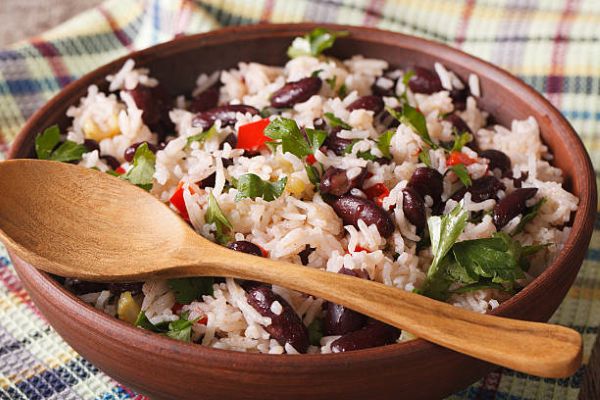
[Due to copyright restrictions, the photo above is from iStock/Getty Images: Gallo Pinto: rice with red beans in a bowl close-up.]