
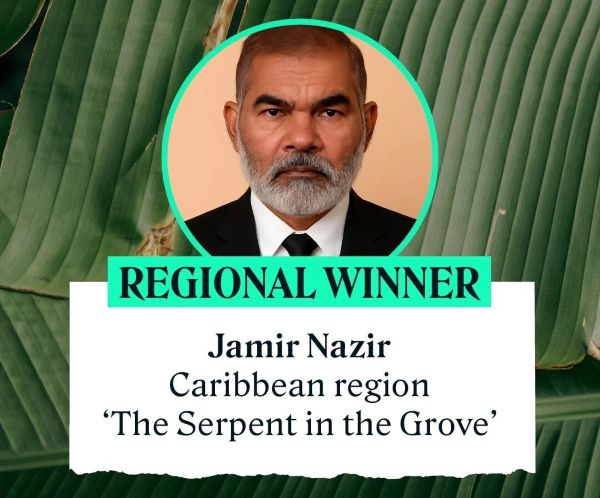
[Many thanks to Peter Jordens for bringing this item to our attention.] Kim Boodram (Trinidad Express, May 21, 2026) reports that Trinidadian writer Jamir Nazir, winner of the Caribbean category of the 2026 Commonwealth Short Story Prize, has been accused of using AI for his winning story, “The Serpent in the Grove.” Here are excerpts.
Trinidadian author and former Commonwealth Short Story Prize Overall Winner Kevin Jared Hosein, in a post yesterday, said the prize is ‘dead’, with the ‘first blow’ being Nazir’s ‘AI-alleged’ short story, and the second the Commonwealth Foundation which supported the writer and the judges who selected his story.
Hosein said of the winning selection, ‘the storytelling is quite poor, and none of his metaphors and simile serve the characters or the narrative’. He said while it was difficult to legally prove the use of AI tools, assisted writing ‘lacks intentionality behind the strangeness it evokes as ‘great’ literature’.
He added that AI-assisted works usually presented ‘disappointing linguistic homogeneity that occurs and reoccurs if you read enough generated fiction’. [. . .] He said parts of Nazir’s work were purely nonsensical and seemed like a product of AI hallucination. Stating that the work ‘reads like marketing-speak’, Hosein said ‘there is no way to 100% prove it is not AI’.
‘But a human judge should not have selected this story as a winner or a nominee in the first place. It should have been immediately banished to the slush. I believe the foundation and the judges need to apologise to the other 8000-and change writers who submitted to this competition in 2026,’ Hosein asserted.
He said as a former judge for this prize in 2022, ‘We are human and have our own failings. Judges are not infallible! They have a no-AI rule for competition entries. But if there is no willingness or visible intention to uphold it, what use is the rule?’ Hosein questioned. [. . .]
An online article from The Guardian out of the UK also reported on the AI allegations against Nazir. It stated that Granta has said the allegations were considered, but no conclusion had been reached. [. . .]
The Guardian reported that shortly after publication, Ethan Mollick, a professor at the University of Pennsylvania, wrote on Bluesky that a ‘100% AI generated story just won the Commonwealth prize for the Caribbean region’. Mollick called it ‘a Turing test of sorts’, and as evidence cited Pangram, an AI detector, which said the work was AI-generated. [. . .]
The other regional winners of the competition were T&T-born Lisa-Anne Julien (South Africa, Africa region); Sharon Aruparayil (India, Asia region); John Edward DeMicoli (Malta, Canada and Europe region); and Holly Ann Miller (New Zealand, Pacific region). The overall winner will be announced on June 30.
For full article, see https://trinidadexpress.com/newsextra/commonwealth-short-story-winner-accused-of-using-ai/article_ea1eabc9-3829-4a76-a8e0-93b266a1210d.html
Also see “AI scandal engulfs prestigious short story prize after multiple entrants accused of fabricating work,” Shahana Yasmin (The Independent, May 20, 2026) at https://www.the-independent.com/arts-entertainment/books/news/commonwealth-short-story-winner-ai-generated-jamir-nazir-granta-b2980039.html
[Also see our previous post https://repeatingislands.com/2026/05/15/commonwealth-short-story-prize-2026-regional-winners-announced/.]