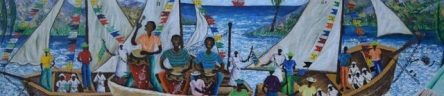

The full title (in Spanish) of this article by Alejandro Ríos (Artburst Miami) is “The Miami Film Festival’s Cuban Film Series premieres ‘Naranjo,’ The Miami Film Festival’s Cuban Film Series premieres ‘Naranjo,’ another unexpected piece of Cuban culture in the diaspora.” Naranjo, a documentary directed by Jorge A. Soliño, traces the trajectory of self-taught artist Orlando González Naranjo.
As part of the Miami Film Festival, the film will have its world premiere on May 22, 2026, at 7:00pm, at the Koubek Center (2705 SW 3rd Street, Miami, Florida). Following the screening, both director Jorge A. Soliño and artist Orlando G. Naranjo will engage in dialogue with the audience. Tickets are free, but you must reserve at https://miamifilmfestival.com/program/event/naranjo/.
Ríos explains:
The [Cuban Film Series] is sponsored by ArtesMiami, a non-profit organization directed by Aida Levitán, which also supports numerous similar cultural events.
Soliño, who last year successfully presented his documentary “Chirino,” learned from actor and playwright Flora Lauten that Naranjo was no longer enjoying the prosperity of his so-called golden years, when he had to leave the home where he had lived for 30 years—and where he created much of his work—to move to a very small place, which plunged him into an unexpected depression.
Soliño describes his first impression upon visiting him in this way: “I heard how the process had unfolded and learned that the artist couldn’t work; his legs hurt terribly and he could barely paint. He had nowhere to store his things, it was very difficult for him to walk in his new environment, and he felt dejected. His story moved me, but what struck me even more was the sense of loneliness and sadness reflected in his paintings. I then resolved to find out where that solitude, those enormous and taciturn eyes, came from.”
What began as an unassuming exploratory curiosity evolved into an interest in documenting the life and work of the artist, who, despite being self-taught, has achieved what so many creators yearn for: the elusive hallmark of a style, the imagery that defines them. The ability to say with certainty: “That painting is a Naranjo.”
A mixture of compassion and a desire for redemption prompted Soliño to activate his filmmaking skills: “I sat down with him so he could tell me his story, I got him some medicine that would help him work again, and after several days, he was able to stand up and start painting again. I began filming him and asking him questions.”
The process, however, required Orlando G. Naranjo to awaken from his creative lethargy. [. . .]

The artist, born in Calabazar de Sagua in 1937, won a drawing competition in 1952. At a young age, he moved to Havana, where he held his first solo exhibition in 1970. Naranjo emigrated to the United States in 1984, convinced that artistic success would allow him to travel the world and one day return to his homeland.
In general, his work is imbued with nostalgia, color, and pain, a refuge where the faces of his “lost paradise” appear— country women with large, unfathomable eyes, rural landscapes, patriotic symbols, and deeply expressive faces that speak of uprooting and survival.
Naranjo’s portraits owe their aesthetic to the colors and radiant light of his native country. On many occasions, they are characterized by compositions that allude to religious icons.
“A painting by Naranjo is an invitation that entices,” Cuban novelist and poet Reinaldo Arenas once wrote. “He dazzles us, starting from a primal innocence, by showing us, with wise simplicity, the modest, forlorn, and glorious wealth of our land,” he points out. “His paintings capture and integrate a gentleness and an essence that, precisely because they are elusive, become all the more dear to us.” [. . .]
Soliño emphasizes the unique circumstances surrounding the life and work of the protagonist of his documentary: “It’s a true story of exile, human fragility, and the power of art as a homeland when other existential anchors dissipate. It tells of how life takes us down unexpected paths, despite our plans and dreams, and the longing to return, even if only for the last time, to the land of our birth.”
The music for the documentary was composed by Omar Hernández, and the animation was created by Mario García-Montes. Post-production was handled by Rafael Hernández, and photos of Calabazar de Sagua were taken by photographer Raúl “El Yuca” Gutiérrez. [. . .]
Excerpts translated by Ivette Romero. For full article (in Spanish), see https://www.artburstmiami.com/articulos-en-espanol/la-serie-de-cine-cubano-del-festival-de-cine-de-miami-estrena-naranjo-otra-pieza-insospechada-de-la-cultura-cubana-en-diaspora
For more information,visit https://miamifilmfestival.com