
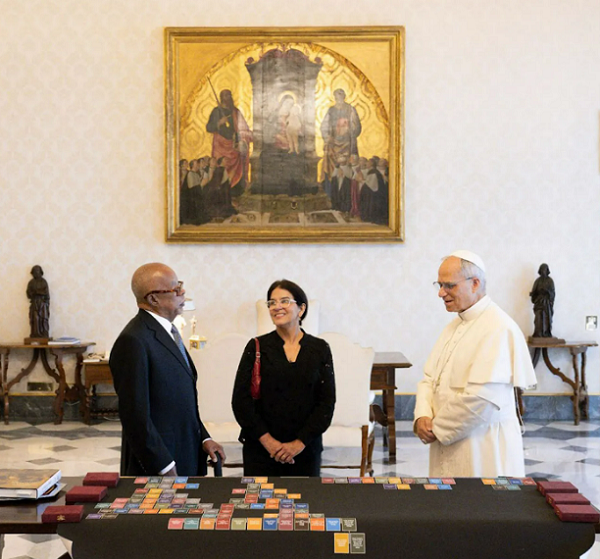
As Peter Jordens—our favorite collaborator from Curaçao—reminds us, Pope Leo XIV recently met with Henry Louis Gates Jr. to discuss his family tree. Jordens writes, “Pope Leo XIV has a family connection with Cuba through his mother (‘Four generations of his mother’s line were born in Havana.’) He also has more distant connections to Venezuela and to Haiti, as the following articles reveal. So, can we call the first American pope in the history of the Roman Catholic Church also the first pope of Cuban heritage?”
And, of course, his extensive New Orleans roots also represent the mix of his European, Black Creole, Latin American & Caribbean connections. As Gates says, “Perhaps the most salient feature of Robert Francis Prevost’s family tree is [. . .] the endlessly fascinating, multifarious geographical and ethnic threads [. . .] that combined to help shape the truly cosmopolitan worldview of the man we might think of as the first pan-American pope.”
The two articles that Jordens shared with us are Christy DeSmith’s ‘To Pope Leo XIV’ (The Harvard Gazette) and “Noblemen, enslaved people, freedom fighters, slaveholders: what the complex family tree of the first American pontiff reveals,” by Henry Louis Gates Jr. (New York Times Magazine). Here are excerpts from each article.
Christy DeSmith summarizes:
[. . .] Packed for a July 5 appointment in Vatican City was a 4-by-5 foot printout of the papal family tree, completed under the direction of Boston nonprofit American Ancestors with assistance from the Cuban Genealogy Club of Miami. Gates and [his wife] Iglesias Utset, a native Cuban who also collaborated on the project, spent 30 minutes with the pope revisiting the lives of more than 100 of his ancestors, with many hailing from France, Spain, Italy, the United States, and Cuba. [. . .]
Born Robert Francis Prevost in Chicago in 1955, the pope has multiple ancestors from Spanish-speaking countries of the Americas. Iglesias Utset highlighted a fifth cousin named Antonio José de Sucre (1795–1830), a key ally of the 19th-century Venezuelan revolutionary Simón Bolívar. “Sucre played a crucial role in defeating colonialism in Latin America,” Gates explained. “The pope was really happy about that.”
The pope asked about ancestors, both Black and white, who were enslavers. He also wanted to know whether he had Haitian ancestry. Gates told him about one ancestor born to native New Orleanians who had immigrated to Haiti during the Civil War. When the fighting ended, the whole family moved back to New Orleans. [. . .]
Henry Louis Gates Jr. writes:
As soon as Prevost became one of the most eminent people in the world, fans of the show wanted to know what mysteries lay in his family’s past. They didn’t have to wait long. Hours later, news broke: The New York Times, drawing on research by Jari C. Honora, a genealogist, revealed that Pope Leo had recent African American ancestors. Prevost’s maternal grandparents, residents of the Seventh Ward in New Orleans, were described in records as “mulatto” and “black.” This was earthshaking news, but we knew it was only the beginning. [. . .]
The initial finding about the pope’s Black ancestry looked back three generations. In collaboration with the genealogists at American Ancestors and the Cuban Genealogy Club of Miami, we were able to identify more than 100 people going back 15 generations and discovered a wealth of fascinating stories. We all agreed that, after more than a decade of doing this kind of genealogical work, the pope’s roots make for one of the most diverse family trees we have ever created. [. . .]
It comes as no surprise, then, that the bulk of the pope’s Black slaveholding ancestors are consistently described as mixed-race. [. . .]
Does his family history mean Pope Leo is Black? That depends on definitions, whether legal, historical or conventional. The historian Daniel Sharfstein points out that while the 1865 Tennessee Black Code defined “Persons of Color” as everyone “having any African blood in their veins,” most legal definitions in the 20th century of who was “Black” depended on the measurement of supposed “fractions” of ancestry, such as one-fourth or one-eighth, which were arbitrary and extremely difficult to gauge (as well as entirely unscientific). By 1910, Louisiana law classified anyone “with any appreciable mixture of Negro blood” as a “colored person.” At least 10 other states followed with their own laws of “hypodescent” — the notorious “one-drop rule.” In 1924, Virginia’s Racial Integrity Act defined as a “white person” anyone who had “no trace whatsoever of any blood other than Caucasian.”
Though self-identification has supplanted, I believe, the legality of the one-drop rule, all too often this sort of thinking remains a powerful social convention when categorizing the genetic gumbo that characterizes the astonishing number of us who are descended from multiethnic, highly admixed ancestral lineages and who are increasingly representing what it means to be “American.” The fantasy of genetic purity is belied by simple commercial DNA tests — and a DNA test would be required to determine the percentages of sub-Saharan African (or Spanish or French or Italian) “ancestor regions” from which Pope Leo might have descended over the last few centuries.
This ambiguity, as well as the sheer heterogeneity of the pope’s ancestry, with its quite colorful, multiple roots and branches, may be what makes it so truly American: a reflection of the complexities of the conquest and settling of the New World, the vast extent of voluntary European immigration and the involuntary, forced migration and enslavement of people of African descent who were brought to the Americas. [. . .]
For full articles, see https://www.nytimes.com/interactive/2025/06/11/magazine/pope-leo-xiv-ancestry-family-tree.html and https://news.harvard.edu/gazette/story/2025/07/to-pope-leo-xiv
[Photo above by Vatican Media: Gates, Marial Iglesias Utset, and Pope Leo XIV.]