
[Many thanks to Peter Jordens for bringing this item to our attention.] Roxanna Marte (for Dominican Today and El Nuevo Diario) asks “Is it time for the expansion of Caribbean literature?”
The positioning of Caribbean literature has long presented a challenge for our countries. We ask ourselves time and again, why does our literature struggle to expand? Why does that anticipated international boom remain elusive while a few writers continue to dwell in a privileged state? How can Caribbean writers continue to earn their place in the global literary canon?
We see examples of writers who have excelled both at home and abroad: Rita Indiana, Reynolds Andújar, Miguel Yarull, Aurora Arias, and Rosa Silverio from the Dominican Republic; Edwidge Danticat from Haiti; Yolanda Arroyo Pizarro, Eduardo Lalo, Mayra Febres Santos, and Pedro Cabiya from Puerto Rico; Karla Suarez, Wendy Guerra, and Jorge Luis Torres from Cuba, among others. They represent the sound, the taste, the flow, the heritage, the hidden history, and the vibrant exuberance of the Caribbean. Indeed, the Caribbean is like a pot of sancocho, where no single ingredient equals another.
I continue to question each day—literature in the Caribbean abounds with questions—why has this positioning proven so difficult? What do we still lack? Clearly, something is missing. Our countries show a stunning lack of support for literature. Few public institutions back literary work, and political will to advance culture and harness its power for society remains scarce. This situation stems from factors that have rarely undergone scientific investigation. We witness, feel, and live a general insensitivity toward literature.
Why is reading so important for our countries? What lasting impact do our writers have on readers and citizens? “A country with better readers is a country with better citizens,” said Laura Niembro, Content Director of the Guadalajara International Book Fair in Mexico, during a conference at the Santo Domingo Book Fair in 2023. Do we, as a Caribbean, hold clear answers? Can we make them tangible? I must confess, I remain uncertain.
This lack of cultural sensitivity has, in my view, kept Caribbean literature stagnant for many years (there is much left to study). My intention is not to cast blame but to stir critical thinking; it is high time to give literature the space and priority it deserves.
On the other hand, the matter is not one-sided. As Caribbean people, we harbor preconceived notions about literature and its possibilities. These ideas, deeply rooted in collective mental models, keep us confined. Immersed in our social and cultural challenges, we often settle for excuses and complacency instead of recognizing the potential that exists. I refer to this as the local syndrome I call “the Island fever.” We rarely acknowledge the unique experience of creating literature in a place like the Caribbean—a privilege not shared by everyone.
I recognize the effort of many individuals in our countries who have labored extensively, sacrificed greatly, and frequently encountered frustration in the face of numerous challenges. The work of independent Spanish-language publishers in the Caribbean, the United States, Spain, and other countries merits praise.
In the Dominican Republic, publishers such as Luna Insomne Editores, Cielo Naranja, Últimos Monstruos Editores (UME), Editorial Anticanon, and Río de Oro Editores have made their mark. In Puerto Rico, Editorial Isla Negra, Gnomo Literario, Las Marías Editorial, Riel Editorial, Editorial de la Universidad de Puerto Rico (UPR), Editorial EDP University, and the Centro de Estudios Avanzados de Puerto Rico stand out. In Cuba, the Cámara Cubana del Libro has paved the way, and publishers like La Pereza Ediciones, Hypermedia Editorial in the United States, Elefanta Editorial in Mexico, and Huerga y Fierro in Spain, among many others, deserve mention.
I also acknowledge that overcoming these obstacles requires unity. We must set aside the recurring systemic oppression that divides us even as we face these challenges. We need to broaden opportunities for those already within the system and recognize the work of those who have devoted their lives and creations to literature—often receiving nothing more than the satisfaction of sowing culture, all while contending with the formidable wall imposed by a general lack of awareness and sensitivity.
“Change people’s minds, change societies,” my great mentors told me many years ago. We now waste a tremendous opportunity to educate and transform our people due to trivialities and insular limitations that hinder development and expansion. Literature stands as one of our best examples of what might be achieved.
Source: https://dominicantoday.com/dr/opinion/2025/03/08/is-it-time-for-the-expansion-of-caribbean-literature
See original article (in Spanish): “¿Será momento para la expansión de la literatura del Caribe?” Roxanna Marte, El Nuevo Diario.
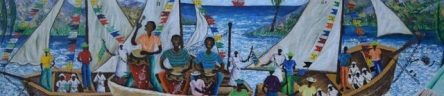
[Photo above by Ivette Romero.]
I think a huge problem with the lack of expansion of Caribbean literature is the fact that we are still dividing the region by language and colonial lines. In this day and age there really is no excuse for it. Caribbean doesn’t just mean Cuba, Haiti, Puerto Rico. It also means Guyana, Jamaica, Belize, Curação, Suriname, even Gabriel García Márquez was very proud of his Caribbean roots and he was Colombian. If we are still not willing to cross colonial lines in global times, how will our literature expand? If we’re not genuinely interested in learning about our own neighbors, who else will be?
Yes, many of us have been arguing this point for ages… And to the linguistic/colonial divisions, we must add gender, class, race and ethnicity. Change happens so slowly (sometimes seeming to move backwards…) One would think we could ALL be multilingual by now.
Yeah and I know our history is a bit more complicated so that’s why it’s slow. But reading and sharing translations could be a good start. For this reason, since I know multiple languages I also like to write and translate things regularly when I can or simply create work in different languages. We should definitely encourage language-learning but just sharing translations that already exist and showing interest in our neighbors could be just as powerful.
The annual “Bookshelf” article in New West Indian Guide attempts to cover Caribbean fiction, drama, and poetry from all across the greater Caribbean, in all languages. Aliyah and others should have a look at it, free and online. The latest installment, “Bookshelf 2024,” which covers some 100 books, can be found at
https://brill.com/view/journals/nwig/99/1-2/article-p130_6.xml?rskey=sWyjfc&result=1
Thanks so much. Indeed, the New West Indian Guide is a great resource!
Respect,
Ivette
Hello Richard, thanks for sharing. I will be sure to check it out. I like to make it a habit to read literature across the greater Caribbean as well and it definitely taught me more about our history in unexpected ways. I think it’s hard to convince a people that literature matters when they don’t see themselves in the literature they read as a kid starting with school. I think the colonial influence is still strong but when people see something that’s actually meant for them it makes a difference.