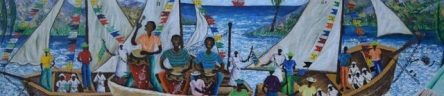

“Carl E. Hazlewood: Infinite Passage” opened on March 22, and will run until July 6, 2025, at Brattleboro Museum & Art Center, Brattleboro, Vermont. Guyanese American artist Carl Hazlewood is a Guyana National Collection artist.
Description (by co-curators Serubiri Moses and K. Anthony Jones): This exhibition is a partially site-specific project that considers the historical origins of the Brattleboro Museum & Art Center building. The former train station embodies the idea ofmovement, which Carl E. Hazlewood calls “an inescapable part of our existence,” specifically as it relates to the movement of enslaved Africans from the continent of Africa to the Americas.
Infinite Passage contains a diverse body of artwork: drawing, painting, and site-specific works. The exhibition positions Hazlewood’s artwork as conceptual guide and a form of inquiry, focusing on ideas of landscape, the aforementioned movement, the trickster figure of African diaspora folklore known as Anansi, and seeing paintings as constructions.
Hazlewood sees landscape as both interior and exterior, referring to both the world in which we live and our emotional landscapes and imaginations. This duality reflects the artist’s philosophy, developed when he was a child in Guyana, on how to navigate the larger world. It also echoes the British and Guyanese painter Frank Bowling, who once said in Nka, a journal of contemporary African art, that his painting exists “in terms of a human being living in this world.” Landscapes can be real places in Hazlewood’s work, such as the plantation where the artist was born—Le Repentir in Georgetown, Guyana. They can also be imaginary, such as those inspired by novels the artist read as a child: Gulliver’s Travels by Jonathan Swift and The Water Babies: Fairy Tale for a Land Baby by Charles Kingsley.
Hazlewood has described the inescapable movement of his people from one landscape to another: from Africa, through the Middle Passage, to Guyana, and then onward to Europe and North America. Yet it is South America that is a crucial site of inquiry for Hazlewood, specifically Guyana, where the Dutch and the British ruled in succession prior to the country’s independence in 1966. Hazlewood describes Guyana as being at the “edge” of empires, located in South America but engaged through language with the Caribbean nations of Barbados, Jamaica, and Trinidad and Tobago.
The ancestral memory of rebellion, particularly the rebellion of enslaved Africans during the 18th and 19th centuries, including the Demerara Rebellion of 1823, also informs Hazlewood’s inquiry and some of the artworks in Infinite Passage. Part of that memory of insurgence includes the narrative that Black folklore is a reflection by the colonized subject. It is within this context that Hazlewood works with the idea of Anansi, a trickster character who perpetually evades getting caught.
Hazlewood’s work includes diamond-shaped paintings that the poet and author Patricia Spears Jones has described as “not quite painting” but rather “construction,” reminding us of the Constructivists of European modern art. In a review of Hazlewood’s work, Spears Jones wrote in BOMB magazine about “the interplay of the constructions’ folds, curves, colors, and negative and positive spaces.” While we may think of Hazlewood as inspired primarily by American abstract painting and modernism, this “Constructivist” view—one of the least discussed aspects of his artwork—shows how his influences come from Guyana, specifically artists such as the late Denis Williams. The “Constructivist” element in Hazlewood’s paintings may have its roots in an approach of Williams’s that Hazlewood described in an essay on Williams as “pictorial mathematics.”
In viewing Infinite Passage, we perceive these somewhat divergent lines of inquiry not as chaotic but as parts of a whole. The exhibition ushers us into a world that is both in disarray and made coherent by Hazlewood’s thought and his art.
CARL E. HAZLEWOOD was born in Guyana. He received a BFA with honors from Pratt Institute, and an MA from Hunter College-CUNY. Parallel to his studio practice, Hazlewood co-founded Aljira, a Center for Contemporary Art in Newark, NJ in 1983. Most recent solo exhibitions include Dia Art Foundation- “Activations: Carl E. Hazlewood at the Chelsea Recreation Center”, Chelsea, March 2023; BlackHead Anansi: Constellations at Charlotte and Philip Hanes Gallery, Wake Forest University, South Carolina (2023); Racing Thoughts-Fever Dreaming at Art Basel Miami Beach (2022); and BlackHead Lyricism at Welancora Gallery in Bedford-Stuyvesant, Brooklyn (2022). Hazlewood has been the recipient of fellowships at the MacDowell organization (2023, 2015); the Brown Foundation at the Dora Maar House, Ménerbes, France (2018); and the Bogliasco Foundation, Italy (2018) among many others.
[Shown above: “Citadel for Anansi,” site-specific installation from Carl E. Hazlewood: Infinite Passage, Brattleboro Museum & Art Center. Photo: Courtesy of the Artist.]
Congratulations Carl. The work looks amazing! Keep making the world beautiful.