
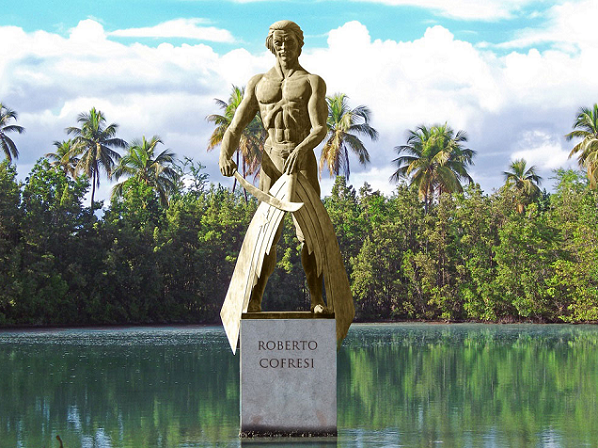
In “The last pirate of the Caribbean / On this day,” James Ferguson (Caribbean Beat, Issue 187 (March/April 2025) writes about “the legend of Puerto Rico’s Roberto Cofresí — the Robin Hood-like figure who was executed for his crimes in front of the El Morro fortress 200 years ago.” This article coincides perfectly with a tribute that will be held in my hometown of Cabo Rojo for Roberto Cofresí (whose real name was Roberto Kupferschein Ramírez de Arellano) and his descendants on the anniversary of his death, March 29. Here are excerpts; read the full story at Caribbean Beat.
[. . .] The great majority of pirates in the Caribbean were born in Europe, sought to make a quick fortune, and gave nothing to the region. Their exemplary violence was described in gruesome detail by Johnson and other historians.
And yet piracy’s positive image persisted even into the 19th century, when “the Caribbean’s last pirate” enjoyed a brief and eventful career. Indeed, his popularity remains intact, and this may be in large part because, unlike the earlier European buccaneers, he was a local hero — born in Puerto Rico where he plied his trade.
Very few pirates reached peaceful old age, and Roberto Cofresí was no exception. He and a number of his crew were executed by firing squad in front of El Morro fortress in the port of San Juan, Puerto Rico, on 29 March, 1825 — 200 years ago. In heroic style, he declined the offer of a blindfold and declared defiantly, “I have killed hundreds with my own hands, and I know how to die. Fire!” His reported final words, whether historically accurate or not, fit into the narrative of the fearless outlaw.
The world into which Cofresí was born — on 17 June, 1791 — was very different from that of the Golden Age pirates. The Spanish Empire, whose treasure-laden galleons were plundered by previous generations of British, French, and Dutch brigands, was in terminal decline — and the newly independent mainland republics were no longer a soft target. The remaining European-owned colonies had reinforced their naval capabilities and were prepared to work together to deter piracy. Puerto Rico, along with Cuba and Santo Domingo, were the last vestiges of Spain’s empire and were struggling economically in an age of regional independence. [. . .]
By early 1823, Cofresí had turned to piracy, working with members of his extended family. The gang operated from the western port of Cabo Rojo but also used the small island of Mona — some 43 miles from Puerto Rico — as a base and were known to frequent the Dominican Republic.
The pirate’s criminal enterprise was small-scale, but extremely busy. Cofresí is thought to have captured and plundered some 70 vessels in two years, but many of these were unarmed trading ships, carrying food and supplies between the Caribbean islands and the mainland.
Alerted by spies at ports, Cofresí’s mini-flotilla of sloops or schooners would intercept non-Spanish vessels, threaten or kill their crews, and steal cash and commodities such as coffee, flour, and leather. These goods were sold illicitly through criminal networks and — so the legend has it — distributed among the poor and needy.
The authorities in the French and British colonies as well as those in the United States were angered by the sudden reappearance of the pirate threat, and a manhunt was organised. Yet Cofresí was seemingly fearless and repeatedly evaded capture, using a stolen six-gun sloop — Anne — as his flagship.
Searches of Cabo Rojo and the surrounding waters yielded nothing until, in early March 1825, a combination of Danish and Colombian sailors located Cofresí and forced him to flee ashore near the Puerto Rican city of Guayama, where he was wounded and arrested.
Cofresí is reputed to have offered a bribe of 4,000 pieces of eight to Guayama’s mayor in return for his freedom, fuelling the legend of a huge hidden treasure hoard.
Cofresí’s death signalled the last gasp of organised piracy in the Caribbean but was also another step in the creation of a pirate mythology. [. . .]
For full article, see https://www.caribbean-beat.com/issue-187/the-last-pirate-of-the-caribbean-on-this-day