
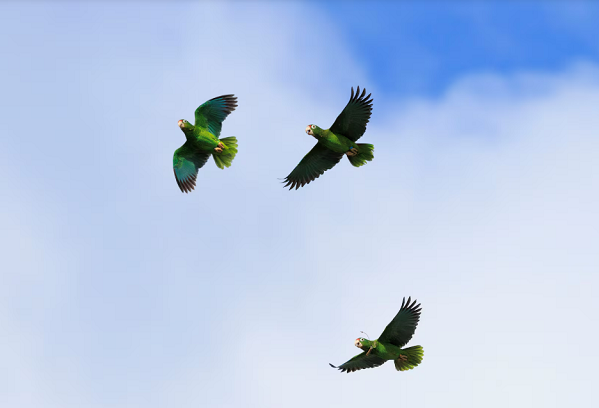
El Nuevo Día toured the Iguaca Aviary, which continues to repopulate the El Yunque National Forest after Hurricane Maria, which nearly wiped out these endemic birds. [See full article and a photo gallery at El Nuevo Día] Adriana Díaz Tirado reports:
In a wild nest—created by biologists and located 70 feet above the ground—two Puerto Rican parrot eggs remained protected. One of them had been laid early Tuesday morning. These future chicks, with green and turquoise wings, will be part of the wild group that will continue to repopulate the El Yunque National Forest [Bosque Nacional El Yunque], which already has a historic number of at least 75 birds of this endangered species.
“From scratch (after Hurricane Maria), we brought the free-roaming population in El Yunque to the highest level in the entire history of the program,” said Thomas White, in charge of captive-to-wild releases from the Iguaca Aviary of the U.S. Fish and Wildlife Service (USFWS) in this municipality.
“They’re there. They’re going in now,” announced the wildlife biologist seconds before a pair of parrots entered their home. Using a wireless camera inside the nest, the wild female was observed entering first. Barely two seconds later, the male, who was born in captivity and remains with a radio transmitter for identification, entered. The bird arrived with food to feed his mate, who was born and raised in the wild. Beak to beak, they shared small mouthfuls of food. The female gave birth to three chicks last year, and this nesting season is already preparing to expand the family of the Amazona vittata, the species’ scientific name.
“That’s our work every day. There are many details, science, genetics, and population management, and strategic planning. They are key to these achievements,” said White, who is passionate about the iguacas, the Taíno name for parrots.
In 1954, when the first study of the parrot was conducted, it was estimated there were around 200 in El Yunque. By the 1970s, only 13 remained. “It was their lowest point. It was an emergency because they were on the verge of extinction,” said White, inside the social cage for these endemic birds. Faced with this reality, the Puerto Rican Parrot Recovery Program was established in 1972. The following year, the first aviary for this species opened in El Yunque, in the Luquillo area. [. . .]
Grandchildren of a [Hurricane] Maria Survivor
More than four decades after the creation of the Recovery Program, between 55 and 57 parrots remained in El Yunque, thanks to the hard work and research of USFWS biologists. However, only two parrots survived Hurricane Maria in September 2017.
During the recovery program at El Yunque, USFWS employees found the remains of some of the parrots. “It was difficult to see so many years of work and progress, since we had started releasing them in 2000. When Maria hit, 20 years of progress were lost in a single day,” White said during the tour.
Hope was revived when “a pair arrived at the aviary that had been released two to three years before” the cyclone. “The female disappeared because a guaraguao [redtailed hawk or Buteo jamaicensis] ate her. The male was then alone; we captured and kept him. In 2020, when we began releasing again after Hurricane Maria, the male was part of the first group released,” White said.
The survivor paired up with another parrot, nested, and fledged alongside three chicks in the first year of release. “My eyes water when I speak about this because it was so symbolic,” he said, mentioning that the parrot now has grandchildren who fledged last year.
The second generation has already had two fledged chicks and is beginning to nest again to lay new eggs this season, which began right at the end of February. “The wild population is not only growing because of the released groups, but also because of its own strength,” the federal official emphasized after 26 years working in El Yunque.
Challenges of the Amazona vittata
For the wildlife biologist, the main and original challenge that caused this species to fall into danger of extinction was deforestation in Puerto Rico. He recalled that, at the end of the 19th century and the first half of the 20th century, the island was largely deforested to use the land for agriculture and urbanization.
“In terms of native factors, the greatest threat is the guaraguao, which is its number one predator. The key is to have a sufficiently large and established population so that, if a guaraguao comes, they can see it and protect themselves. Experience makes them smarter. The more parrots there are, the more trained the population is. They have more eyes, and they protect one another other because they are very social beings,” he explained. In addition, the researcher warned of an “emerging problem” in western Puerto Rico with the boa constrictor, an invasive species that is harmful to the endemic fauna. In Maricao, “they have lost several parrots to this exotic boa,” he lamented. [. . .]
“For the reproduction of any species, the ideal is to have a self-sufficient population that doesn’t require human intervention. We’re a long way from that, but that is our goal,” he added.
One of the strategies of the Recovery Project, in partnership with the Department of Natural and Environmental Resources, has been to disperse the parrot population between El Yunque, the Río Abajo State Forest [Bosque Estatal de Río Abajo], between Utuado and Arecibo, and the Maricao State Forest [Bosque Estatal de Maricao]. [. . .]
Translated by Ivette Romero. For full, original article (in Spanish), see https://www.elnuevodia.com/ciencia-ambiente/flora-fauna/notas/libres-en-el-yunque-cotorras-puertorriquenas-silvestres-marcan-record-historico/98
[Photo by Ramon “Tonito” Zayas: Three of the 75 Puerto Rican parrots in the wild in the El Yunque National Forest fly near the Iguaca Aviary.]