
Several countries touching the Caribbean Sea have growing concerns about the ever increasing appearance of Sargassum seaweed. The governments of Mexico and Grenada are two examples of those actively working to find productive solutions.
Last October, Prime Minister Dickon Mitchell said that Grenada would transform 10,000 tons of sargassum into useful products by 2026. SarGas, a start-up founded in 2023 has started to turn Grenadian sargassum into biofuel.
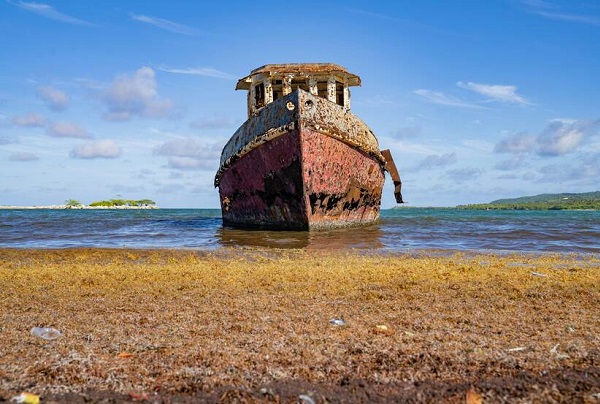
Mexico has underlined its Commitment to permanently implement actions that contribute to reducing the arrival of sargassum on the beaches of the Mexican Caribbean. The well-planned phases for these efforts, aided by the University of South Florida, include Preparation (maintenance and preparation of infrastructure), Detection (satellite monitoring and maritime surveillance), Containment (installation of containment barriers, use of sargassum vessels…), and Collection (collecting sargassum in shallow waters and delivering it to the municipal authority). [For more information on these efforts see press release from Mexico’s Ministry of the Navy. The photo above— by Dominican photographer Aldward Castillo—is from the Dutch Mission to Cancun site.]
Here are excerpts from Fox Weather:
According to marine experts with the University of South Florida, 2025 could be another major Sargassum year. It is too soon to determine if the seaweed will plague Florida like in 2023, but any widespread reports likely would not happen before the summer. The origins of the Sargassum explosion are somewhat murky, but experts believe fertilizer runoff and deforestation in South America may be primary sources.
The Mexican government has announced plans to intensify efforts to combat the annual influx of sargassum seaweed along the shores of its major tourism hubs, as the seasonal invasion is expected to begin in just months.
As part of the government’s Sargassum Response Strategy, officials say they will focus on discovery and containment efforts in the waters surrounding nearly four dozen popular beaches along the Yucatán Peninsula and Caribbean coast.
The government reports that sargassum typically washes ashore between April and October but, due to climate change, its increased presence has become particularly problematic in recent years. The foul odor and unpleasant sites produced by the seaweed can impact tourism and marine ecosystems. Communities highlighted by the government’s plan include areas around Cozumel and Playa del Carmen, which are popular destinations for cruise lines. The foul odor and unpleasant sites produced by the seaweed can impact tourism and marine ecosystems.
The country’s plan is composed of four key phases consisting of preparation, detection, containment and collection. The government says it’ll concentrate on the first phases, making sure barriers, boats and personnel are ready until the threat for containment and the need for collection arises.
While the seaweed might look unpleasant, health experts say it is largely non-harmful to humans. Tiny creatures that bury in the globs can produce rashes and blisters if contact is made with the skin. For some species of marine life, the brown algae is considered to be helpful, and biologists believe that the buildup provides food and refuge for small fish, crabs, shrimp and other organisms.
2025 could be another year for increased activity
Marine experts at the University of South Florida are warning that early indications from observations across the Atlantic basin indicate that 2025 could be another busy year for algae. While levels continue to be low in the Gulf and the Caribbean Sea, amounts of seaweed in the western and eastern Atlantic exceed the 75 percentile, with more than 7 million metric tons detected. [. . .]
For more information, see https://www.foxweather.com/earth-space/brown-algae-sargassum
For related articles, see https://advancedbiofuelsusa.info/how-the-caribbean-could-turn-a-plague-of-seaweed-into-fuel-and-fertilizer
Also see the Sargassum Information Hub at https://sargassumhub.org/mexico/containedaquifers
[Photo above by Aldward Castillo. See https://www.agroberichtenbuitenland.nl/actueel/nieuws/2025/01/17/sargassum-mission-to-cancun#effectively and https://unsplash.com/es/fotos/un-barco-oxidado-sentado-en-la-cima-de-una-playa-de-arena-CgGImGmv-K4]