The 61st International Art Exhibition of La Biennale di Venezia, In Minor Keys (May 9 to November 22, 2026), will feature 111 invited participants – among them, individual artists, collaborative duos, collectives, and artist-led organizations – from many different geographies and regions. The Biennale will feature a strong Caribbean presence. Key highlights include The Bahamas Pavilion returning after 13 years with Lavar Munroe and the late John Beadle, alongside numerous artists in the main exhibition, including Alvaro Barrington, Daniel Lind-Ramos, and Annalee Davis.
The Grenada Pavilion will be at Spazio Berlendis, with “a reflective mode of cross-cultural dialogue, titled ‘The Poetics of Correspondence.’” Artists in the Grenada Pavilion include Edward Bowen, Arthur Daniel, Josine Dupont, Alexandra Kordas, Lilo Nido and Chris Mast, The Holzwege Group, and Russel Watson.
Here are excerpts from various sources and a list of artists that represent Caribbean connections in the main, international exhibition. [My thanks to Peter Jordens for helping with the list.]
Exhibitions will be located at the Central Pavilion in the Giardini, the Arsenale, and in various locations around Venice. The program will also include outdoor installations, performances that will “center the body as a site of knowledge and memory,” and a procession of poets in the Giardini. [. . .] The pre-opening will take place on May 6, 7, and 8, while the awards ceremony and inauguration will be held on Saturday, May 9, 2026.
After the premature passing of Koyo Kouoh in May 2025, with the full support of her family, La Biennale di Venezia decided to carry out her Exhibition, with the purpose of preserving, enhancing and widely disseminatingher ideas and the work she pursued with such dedication to the very end.
The main exhibition focuses on themes of diaspora, memory, and, according to ArtReview. Caribbean representation includes the following artists:
- Álvaro Barrington: Venezuelan Grenadian/Haitian artist based in London.
- Maria Magdalena Campos-Pons: Cuban-born artist, in collaboration with Kamaal Malak.
- Carolina Caycedo: UK-born Colombian artist. Currently (2025-2026) an artist-in-residence at Para La Naturaleza in Puerto Rico.
- Annalee Davis: Barbadian artist focusing on post-plantation economies.
- Edouard Duval-Carrié: Haitian artist based in Miami.
- Sofía Gallisá Muriente: Puerto Rican visual artista and filmmaker.
- Natalia Lassalle-Morillo Puerto Rican theater artist, filmmaker, performer and visual artist, in collaboration with her mother Gloria Morillo.
- Daniel Lind-Ramos: Puerto Rican artist known for large-scale assemblages.
- Lugar a dudas: An art school/center/collective, led by Oscar Muñoz, and based in Cali, Colombia. See https://www.lugaradudas.org.
- Manuel Mathieu: Haitian-born painter.
- Ebony G. Patterson: Jamaican artist.
- Tabita Rezaire: French-Guianese artist.
Motifs. Koyo saw several conceptual motifs guiding the exhibition. These were not abstractly determined but rather sifted from a reservoir of art that acts deeply on the soul and mind. They brought into focus a compositional method for the exhibition, which is not organised according to sections but rather in respect of undercurrent priorities. Among these are “Shrines” – in which prominence is given to the practices of two lodestar artists while exceeding a retrospective impulse; processional assemblies; enchantment in the face of cynicism about what art can do; spiritual and physical rest opened up by the oases – the keys or small islands of artists’ universes; and finally, Koyo’s commitment to artist-centred institution building or “Schools”, in which energy and resource is directed towards a social purpose.
Literary references. These strands leap from practice to practice, snaking an intergenerational path to build across the sites of In Minor Keys. During the curatorial work, many ideas resonated with the literary references shared by Koyo as sources of inspiration, among them, Beloved by Toni Morrison and One Hundred Years of Solitude by Gabriel García Márquez, texts that connect in their evocation of thresholds between lifeworlds and temporalities and by a magical realism which deepens rather than distracts from an emotional register.
Procession. The procession’s motif, inspired by carnival choreographies and Afro-Atlantic gatherings, expresses a dynamic spatial language in which joining the crowd, rather than observing, is requisite and implied. In this carnivalesque dimension, capable of suspending and subverting hierarchies, many artistic practices challenge archives and canons, reinterpret established symbols, and demystify dominant narratives through transhistorical, speculative, or rigorous approaches.
Schools. The “Schools” emerge as ecosystems rooted in their local territories and, at the same time, transnational: spaces of learning and regeneration founded on encounter, shared knowledge, and autonomy from market forces. Integrated into the constellation of the exhibition, they reflect a shared ethic and a collaborative practice that intertwines art and social responsibility.
Rest. Themes such as the plantation, colonial settlement, environmental disaster, and geological memory traverse other works, which confront seismic events and their traces through radical and liberatory methods. At the same time, the Creole garden and the courtyard — spaces of self-sufficiency born under conditions of constraint — become both real and metaphorical places of rest, reconnection, and engagement with non-human forms of life. The Exhibition ultimately reflects on the possibility of stepping back from the encyclopedic impulse to make room for rest, contemplation, and deep listening. Multisensory installations encourage rêverie and enchantment, inviting visitors to slow down and allow themselves to be transformed by the experience. Through oases that evoke studios, courtyards, and learning spaces, In Minor Keys conveys the spirit of a project that weaves together collaboration, generosity, and trust in the multiple dimensions of our shared humanity.
Performances. The program of performances centres the body as a site of knowledge and memory, as well as a political vessel for collective resistance and healing.
A procession of poets will take place in the Giardini della Biennale, inspired by Koyo’s Poetry Caravan, a voyage she undertook with nine African poets from Dakar to Timbuktu in 1999. The performance honours her memory and opens a space for poetry and storytelling. It pays homage to the griots who seek the source human dream to spread the wings of knowledge and power. In the Giardini of La Biennale, poets will assemble to form a chorus vested with the power of the word, the groundswell of recital and spiritual healing. [. . .]
For all sources, see https://www.plateapr.com/que-saber/artistas-boricuas-en-biennale-di-venezia-2026, https://www.artnews.com/art-news/news/venice-biennale-2026-artist-list-koyo-kouoh-1234774417/, https://www.labiennale.org/en/news/biennale-arte-2026-minor-keys-0 and https://www.labiennale.org/en/news/biennale-arte-2026-invited-artists
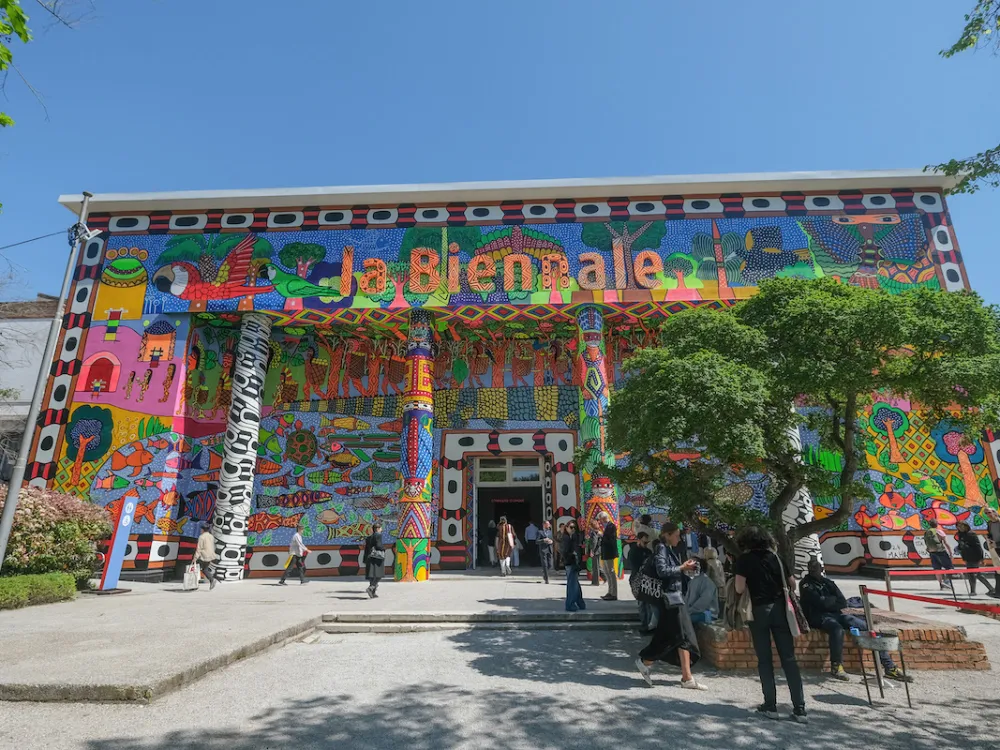
[Photo above by Stefano Mazzola/Getty Images.]
It is quite disheartening that Grenada will present its official national pavilion, our 9th appearance, and we are continuously left out of regional mentions. Please see our website grenadavenice.org
Thank you so much for letting us know. It is very hard to keep track of all news! We appreciate your feedback and help!
Ivette