
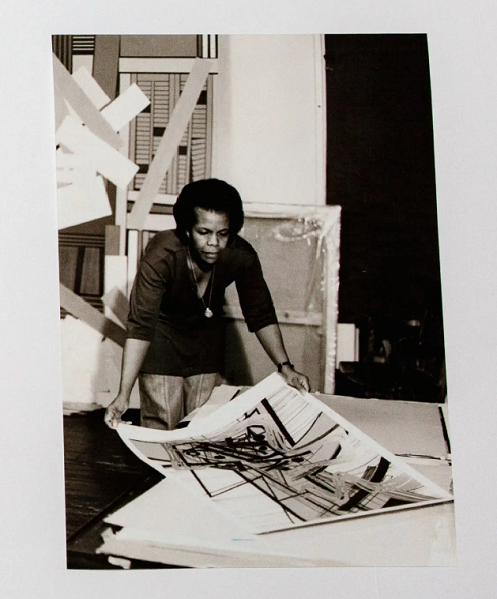
[Many thanks to Joan Snyder for bringing this item to our attention.] “Mavis Pusey was a pioneer of Black abstraction before she was nearly forgotten. A new show in Philadelphia begins a journey of rediscovery.” Siddhartha Mitter reports on the Jamaican-born artist for The New York Times (19 July 2025).
In the prime of her art career, before the money dipped too low and the landlord sold her ramshackle Chelsea loft, Mavis Pusey would roam New York City, gauging its ever-changing condition. It was the 1970s and early 1980s, and there was much that compelled her: the ruin and repair, clearance and construction, the dance of buildings and workers and passers-by.
She sometimes took photographs to remember the forms that she noticed. The round windows like portholes cut into construction fences. The peculiar slant of some boards on a truck bed. A pile of bricks. Two utility workers on a cherry picker, its mechanical arm raised high.
Back in the studio, these references might work themselves into one of her large-scale oil paintings, a drawing in graphite or marker, or an etching, lithograph or silk-screen. They integrated her visual vocabulary — a language of stacked, swirling, tumbling geometric forms, abstract yet abrim with life.
To Pusey, who was born in Retreat, Jamaica, in 1928 and came to New York City in 1958 — first to study fashion design, and then fine art — the urban condition, it seems, was bittersweet but always vital, and her art sought its ambivalent essence.
“I love buildings that are being torn down, though I hate to see them torn down,” she said, in one of her rare art talks for which a transcription or tape survives. “They have a sadness, they have an excitement about them; you will see sadness and yet you see forms and movement and emotion. And because I like them, I fantasize about what happened inside of them.”
In time, Pusey herself became the mystery. Once a full-fledged participant in the New York milieu of Black artistic innovators — the printmaker Robert Blackburn and the painter Emma Amos were among her friends; she was said to throw great dinner parties — she left the city in 1988 for rural Virginia and soon seemed to disappear. When she died in 2019, at age 90, she was all but forgotten.
No longer. “Mavis Pusey: Mobile Images,” a survey of Pusey’s work, is now on view at the Institute of Contemporary Art in Philadelphia (through Dec. 7). It caps a decade of sleuth work by curators who, starting with few leads, succeeded in locating her artworks, her papers and indeed, before it was too late, the artist herself. The exhibition has been organized with the Studio Museum in Harlem, which will present it in 2027; it will travel first, in fall 2026, to the Hammer Museum at UCLA.
For Thelma Golden, the director and chief curator of the Studio Museum, showing Pusey offers a vital encounter with Black abstraction and its engagements. “She gave herself the opportunity to be incredibly bold in her sensibilities as she sought inspiration in the world around her,” Golden said. She added, “Her work existed in a moment that wasn’t potentially ready for it.” [. . .]
For full article, see https://www.nytimes.com/2025/07/19/arts/design/mavis-pusey-pioneer-black-abstraction.html1
3 thoughts on “This Groundbreaking Artist Vanished. A Decade of Sleuthing Reveals Her Greatness.”