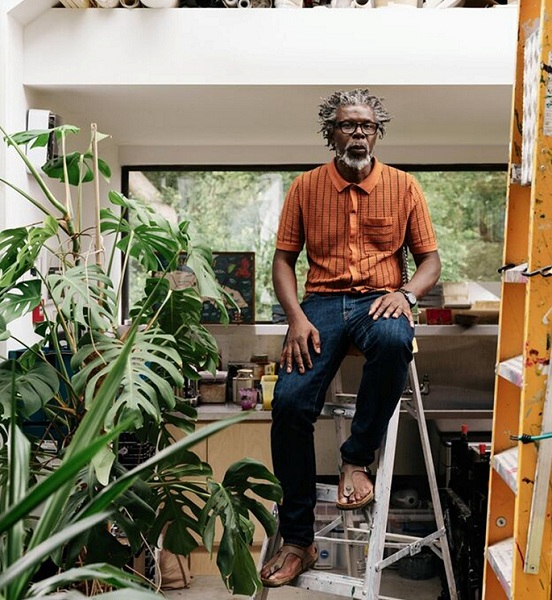
Precious Adesina (Artsy) interviews artist Hurvin Anderson, whose solo exhibition (“Hurvin Anderson,” curated by Dominique Heyse-Moore) will be on view at Tate Britain through August 23, 2026. Adesina highlights the author’s trajectory, main themes, and sources of inspiration and exploration. Read the full article at Artsy. [Extremely grateful to Peter Jordens for bringing this artist to my attention. I am now a fan!]
In Ball Watching (1997) by the British painter Hurvin Anderson, a group of boys stand on a patch of grass by a lake. The sky is a hazy blue, the water a vivid turquoise. The green beneath them, as they face away from the viewer, contrasts with the dark gravel behind, isolating them in what feels almost like their own tropical island.
Anderson returned to this scene repeatedly between 1997 and 2010, turning a 1983 photograph he took in the overgrown Handsworth Park in Birmingham, U.K., into an emotionally charged vision of both his hometown and the Caribbean, where his parents immigrated from. In a later version, Ball Watching (Five-a-Side) (2010), Caribbean trees dominate the skyline, their usual vibrancy muted by washes of gray.
“The way the ball was in the middle of the photograph in the middle of the pond, it seemed like the moon had fallen out of the sky,” he said in a recent interview. Throughout his career, such atmospheric explorations of home and belonging have become his hallmark.
Hurvin Anderson’s major retrospective
Now 61, Anderson spoke to me at a café at Tate Britain ahead of his largest presentation to date. Curated by Dominique Heyse-Moore, senior curator of contemporary British art at the institution, “Hurvin Anderson” will be on view through 23 August. It brings together more than 80 works spanning three decades. [. . .]
When we met, Anderson was dressed casually in a green beanie hat, blue polo shirt, and gray fleece. His friend, the renowned British artist and academic Keith Piper, waits for us nearby. It’s two weeks before the opening, and Anderson is in the middle of installing the show. Despite being widely described as one of the leading painters in the country—in 2021, his swimming pool scene Audition (1998) sold at Christie’s for more than $10 million, one of the highest prices achieved at auction by a living Black British artist—he remains unduly modest. [. . .]
Themes in Anderson’s paintings
Anderson is predominantly known as a landscape painter who often depicts the Caribbean and England, referencing his own sense of in-betweenness, which many immigrants can relate to. His paintings are “usually looking at a particular mood, time of day, a particular corner, a particular home,” said Heyse-Moore. “But then there’s always the thought of another place.”
Anderson described his work as being about “travel,” which encompasses both physical migration and leisure. His parents moved from Jamaica to Birmingham, England, in the early 1960s as part of the Windrush generation: Caribbean migrants invited to Britain to work between 1948 and 1973. Out of his parents’ eight children, he was the only one born in the U.K. Anderson grew up hearing about Jamaica, which he first visited as a teenager in 1979. His work shows a deep affinity to the country and its landscapes, often depicting spaces occupied by immigrants. “It’s part of Black people’s condition—wrestling with this idea of wanting to be somewhere else,” he explained. “If it’s not [as a result of] history, [for example], slavery, it’s migration because of poverty, or potentially now, again, because of the political situation—that state is always there.”
Anderson’s impressionistic oil paintings also traverse French art history, and paintings of leisure in particular. “I was slightly obsessed with [Edgar] Degas and the small painting in the National Gallery called Young Spartans Exercising (1860) and [those by] Georges Seurat,” he said. “I can’t escape my connection to those paintings.”
Painting a wider history of migration
Anderson’s long-running series of barbershop paintings, which he began in 2006 and continued for almost two decades, bring his explorations of belonging indoors. His “Peter’s Series” in particular, which he started in 2007, portrays an attic converted into a makeshift barbershop that his father frequented. With white barbers reticent to cut Black hair, Caribbean immigrants of the 1950s and ’60s would cut one another’s hair at home. [. . .]
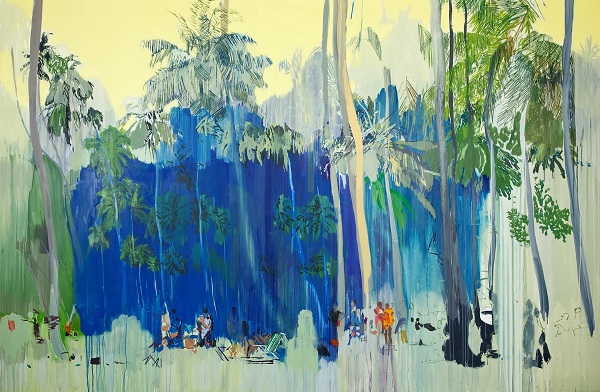
While the political elements of Anderson’s paintings are often subtle, his recent body of work is more explicit. Passenger Opportunity (2024–25), commissioned by Pérez Art Museum Miami, explores the wider social history of migration between Jamaica and Britain. “It’s probably the most ambitious work in the show,” said Heyse-Moore of the 13-by-32-foot piece. [. . .]
For full review, see https://www.artsy.net/article/artsy-editorial-hurvin-andersons-luscious-paintings-explore-meaning
Also see our previous post https://repeatingislands.com/2026/04/02/exhibition-hurvin-anderson-tate-britain/
[Photos above: 1) Portrait by Lewis Ronald: Hurvin Anderson in his studio, 2024. Courtesy of the artist and Tate. 2) Photo by Richard Ivey. Anderson’s Maracus III, 2004. Courtesy of the artist and Thomas Dane Gallery.]