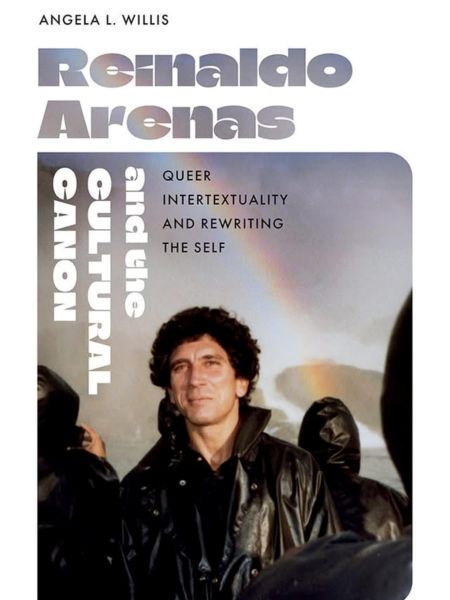
Many thanks to my dear colleague and friend Rafael Ocasio for sharing news of a new book— Reinaldo Arenas and the Cultural Canon: Queer Intertextuality and Rewriting the Self (University of Florida Press, 2026) by Angela L. Willis. This study explores how Arenas “reimagined literary classics as queer, subversive parodies that undermine oppressive power.” The book is now available for pre-ordering (with the Discount Code: 31AU326).
Description: This book offers a fresh reading of the work of Reinaldo Arenas, showing how the Cuban writer reimagined literary and visual classics as parodies that challenge oppressive power structures. Incorporating his own life experiences, Arenas transformed canonical figures, genres, and narratives into carnivalesque intertexts that dismantle dominant ideologies. By queering Cuba’s past and present, this book shows, Arenas’s works offer a creative blueprint for resistance.
Angela Willis demonstrates how Arenas drew heavily on established sources—repurposing early texts on the Spanish Inquisition, mimicking novels set on colonial Cuban plantations by José Lezama Lima and Cirilo Villaverde, and engaging with visual works such as Bosch’s The Garden of Earthly Delights. Taking a comparativist, intertextual approach, this book offers new ways to explore the texts Arenas parodies. It also discusses two overlooked pieces by Arenas—an unfinished film script of Lezama Lima’s Paradiso and a key essay on “avant-garde” narrative—along with the original manuscript and audio tapes linked to the writer’s autobiography, Antes que anochezca (Before Night Falls). The close readings and little-known archival materials in this book provide new insights into Arenas’s artistic dissidence.
Angela L. Willis, professor of Hispanic studies and Latin American studies and assistant dean of educational policy at Davidson College, is coauthor of The Dissidence of Reinaldo Arenas: Queering Literature, Politics, and the Activist Curriculum.
For more information, see https://floridapress.org/9781683406242/reinaldo-arenas-and-the-cultural-canon/